Showing posts with label Sherlock Holmes. Show all posts

Friday, September 28, 2012

Elementary.... Sherlock Holmes in 21st Century New York

When it was announced that CBS would be doing their own modern take on Sherlock Holmes (after the BBC wouldn't allow them to remake Sherlock) fans of Holmes were startled and alarmed. Especially when it was announced that Watson would be played by Lucy Liu. It certainly goes against tradition.
So was it worth all the kerfuffle?
In some respects no. In last night's pilot of Elementary, Lucy Liu proved herself very adept at being the every man foil to an unhinged detective. As the element people were most worried about, she was a pleasant surprise. From a design point of view, she also had a very good "look." I also don't mind the New York setting. It can work.

I suppose my main criticism of the show thus far (and I realize most network shows need to settle in over the first few episodes) is that it's sort of bland. Johnny Lee Miller's Holmes is an arrogant detective and recovering drug addict. Yes, he may have the capacity to be an interesting character, but he's not yet. Nothing is really screaming "Holmes" about him either. He keeps bees, that was the one token quirk they threw the audience last night. The possibility of Holmes' father is new to the pastiche genre and may have some possibility, but I'm still not convinced by the writing or Miller's portrayal of the character. He doesn't have the mystique or the charisma yet.
The NYPD is also really boring. So far we've seen Captain Gregson who worked with Holmes while he was abroad attached to Scotland Yard. Their history and relationship doesn't really read at this point. Detective Abreu seems like someone Holmes might rub the wrong way. In their first scene, Holmes disproves the Detective's assumptions about a crime scene. Yet, later in the episode he does Holmes' bidding with little trouble. Right now the police are just placeholders, filling a function, not real people with internal lives and the possibility for conflict.
I wish they hadn't advertised this as a Sherlock Holmes adaptation. If they had changed everyone's names, I would have no trouble enjoying it as a new "consulting detective" show on CBS. We could have had a show that pays homage to Holmes in its inspiration instead of a "Sherlock Holmes" show that never quite delivers.
There is a good possibility that the show will find its footing and be quite decent. But nothing so far says it's Sherlock Holmes to me. Sherlock Holmes wouldn't have kinky ladder sex with a prostitute. I also don't believe that he would ever have a "temper tantrum" to the extreme he does in this pilot. His mind is always in control. He may do bizarre things, but it's for a purpose, a master plan. So far, I'm not certain Miller's Holmes is capable of the "long-game," if you will. How will he cope when a Moriarty is eventually introduced?
Some fans are rejoicing the fact that Miller is an attractive and competent actor that they can enjoy in the role for twenty or so episodes per season. Yes it's hard to wait a year and half for each set of three episodes from Sherlock, but they are more than episodes, aren't they? They're really mini-films. "A Study in Pink" held up side by side with this first episode creates a sad comparison. Really, there is no comparison. Elementary is.... HolmesLite. We'll be getting a decent, Sherlock Holmes-ish series in great quantity, but nowhere near the quality and detail of Sherlock.
So will I watch it? Probably. At least unless they do something that's unforgivable to me. It's just an entirely different beast from Sherlock.

Saturday, February 18, 2012

Review: Professor Moriarty and the Hound of the D'Urbervilles


From the back cover: "Imagine the twisted evil twins of Holmes and Watson
and you have the dangerous duo of Professor James Moriarty- wily, snake-like,
fiercely intelligent, terrifyingly unpredictable- and Sebastian 'Basher' Moran-
violent, politically incorrect, debauched. Together they own London crime,
owning police and criminals alike."


If The Adventures of Sherlock Holmes are well thumbed in your library, you may find it interesting to puruse this collection of the adventures of Professor James Moriarty as told by his right hand, Sebastian Moran.
From their Conduit Street rooms, Moriarty runs a crime syndicate that encompasses all of London and has international connections as well. Moriarty arranges the mathematical crimes and Moran is his trusted gun hand, back from military service after nearly being clawed to death by a tiger which he then killed. The two men have a career of the most creative sort of crimes; from making the mistake of taking Irene Adler as a client, to a most delicious revenge against one of the Prof's former pupils, to the title story which chronicles their own investigation into a cursed family.
Holmes and Watson are boy scouts, comparatively. Moran and Moriarty are vicious, misogynistic, and anarchic, but immensely entertaining. Occasionally crude, but definitely colorful, Moran as our narrator ingratiates himself and by the end of his story is actually almost a sympathetic figure.
The book is divided into seven tales, some of which are stronger than others. "The Red Planet League" stands out as especially clever and humorous. After "The Hound of the D'Urbervilles" story arrives in the middle of the book, there is a slight dip in the story. Perhaps it's because the initial naughty pleasure of the insane concept has waned, or perhaps because we want to see the stakes raised more. However, the final story, "The Problem of the Final Adventure" is worth hanging on for. The raucous tone of the opening tales is subdued, but here's where we see some of that character development, the raising of stakes, and a surprising bit of pathos from our narrator.
Fans of the stories of Arthur Conan Doyle will see plenty of references and parodies from his Holmes tales throughout the novel, as well as some little digs at Doyle's continuity problems (Moran explains that all three Moriarty brothers are named James because their parents liked the name so much). No literature is safe, however. The title story concerns the D'Urberville line, yes, Tom Hardy's D'Urbervilles. Little passing references are also made to Poe's mysteries, Leroux's Phantom of the Opera, and even a nod to H.G. Wells. End notes, some more sarcastic than others will direct you to some of the allusions you may miss.
The treatment of Holmes in the story is a little odd. He makes very little appearance, though of course in the story of Holmes' adventures, neither does Moriarty. Implied off-stage tinkering serves as all the back story for their relationship in both accounts. Moriarty's view of Holmes is so very different than the view an affectionate audience has, that it's a little unsettling. Perhaps author Kim Newman intended it to be. Moran fiercely insists that Holmes was not Moriarty's arch enemy, but another slippery criminal trying to take Moriarty's place, Holmes was just bad timing, the last nail in the coffin of their crumbling criminal empire.
If you love the various incarnations of Moriarty and enjoy a bizarre romp through literature and crime, you should definitely give this book a try. Are the scenarios totally improbable? Yes. Are some stories less gripping than other? Yes. It still may be worth your time though. Sometimes the absurdity really is the point. Your pastiche collection won't be complete without this oddity.

Wednesday, January 18, 2012

Review: The Reichenbach Fall, Sherlock series 2


On Sunday, The Reichenbach Fall, the series 2 finale of Sherlock aired. Based off Doyle's story "The Final Problem" (a title which is referenced several times in the episode), the episode opens with John back at the therapist's office. He tells his therapist he's come back after all this time because his best friend, Sherlock, is dead.
From there we get the story filled out. Sherlock steadily gains more and more media exposure through John's blog and the solving of several high profile cases. John warns him that this might be dangerous. Meanwhile, Moriarty is back with the ultimate plot. He has a computer code that can open any security system. He simultaneously breaks through the security of The Tower of London, The Bank of England, and Pentoville. It's going to be the trial of the century and Sherlock will be the main witness for the prosecution.

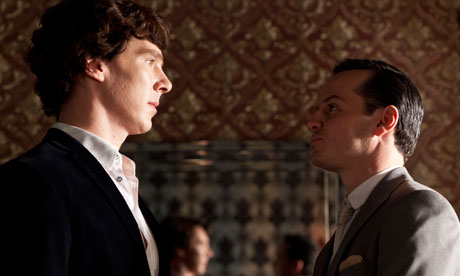
The episode was a fantastic cap for the season. It was great to have more screen time for Andrew Scott as Moriarty. This version of Moriarty is certainly unique, but he's always exciting to watch. His Moriarty is brilliant, unpredictable, and relishes the game so much. He's delicious to watch, and he scenes between Sherlock and Moriarty are extremely powerful. Their verbal chess match towards he end of the episode contains several surprising twists. Scott's versatility comes through and there's a scene about an hour into the episode where he might make you momentarily question your sanity.
This episode lets us see Sherlock at his most desperate. This whole season has been about uncovering his vulnerabilities, finding what's really important to Sherlock and this episode takes that even farther. By the end of the episode you may have to disagree with Sherlock's earlier assessment that "Heroes don't exist, and if they did I wouldn't be one of them."
It was Martin Freeman's performance, however, that really made the episode. Give that man another BAFTA. His ability to emote, but emote in a controlled way that would be appropriate for John Watson, the soldier and doctor, is so subtle and deft. It's heartbreaking to see him in pain, more heartbreaking when he tries to be strong about it.

The series as a whole definitely lived up to expectations. The success of the first season gave the writers more license to push boundaries and experiment, some experiments were more successful than others, but they were always entertaining.
The direction and overall cinematography put this leagues above any other show on television. The transitions between scenes are always visually interesting and cleverly done. The creation of atmosphere, whether in on the moors, or in the middle of London, grab hold of the viewer. They found even more interesting ways to visualize Sherlock's thought process this season as well-- the "Mind Palace" sequence from Hound was definitely a highlight, and possibly a new dance move.
The end doesn't leave on as painful a cliff hanger as the first season, but will leave fans eager for more, and indeed, a third season has been commissioned. Unfortunately it won't arrive until 2013 due to the filming of The Hobbit which Martin Freeman stars in with Benedict Cumberbatch supporting as Smaug.

Friday, January 13, 2012

Review: Sherlock "The Hounds of Baskerville"


In a nod to a lesser known, lesser adapted Holmes story "Black Peter," the episode opens with Sherlock arriving back at the flat covered in blood and carrying a harpoon he used to spear a pig that morning. He had to take the tube home "None of the cabs would have me." With that slightly gorey start, writer Mark Gatiss takes us on a horrific adventure into Dartmoor on the tail of a giant hound. Henry Knight arrives on the morning train asking for Sherlock and John to help him. Twenty years before, his father was ripped apart in front of him by what seemed to be demon hound- possibly an escaped genetic experiment from Baskerville, a government testing facility nearby.
The episode did a great job of inverting some of the expectations that Holmes fans would have for an adaptation of Hound of the Baskervilles. No longer set in a creepy country home haunted by a curse, it takes the story to that modern haunted house, a laboratory where anything could lurk. Many moments of pure psychological terror were in store for all of the characters, even Sherlock our cool logictician. How can Holmes deal with fear and doubt, the inability to trust his own senses? How can Watson deal with such a Holmes?
Our two leads had an opportunity to explore a new aspect of their relationship. One where Sherlock tests certain limits. More importantly, we see John hurt by Sherlock when he insists in one taut scene, "I don't have friends!" By the end though, Sherlock has to relent that he doesn't have friends, just one friend.
Though the episode pays homage to Doyle's original creation, it steps boldly into new territory, allowing itself to differ from the original. Hound is the most adapted Sherlock Holmes story, one that carries with it a lot of baggage. Gatiss sheds much of that baggage by reinventing several aspects of the story and giving fans something fresh and original, something they won't be as familiar with.
Overall, it was a very strong episode. It continues on the momentum created by the raucous first episode and keeps giving us something new from our characters, which can be hard when they are so established in the public consciousness.

*Here there be spoilers:*
One small issue I did have with episode was how the characters were exposed to the hallucinogen. It wasn't in the sugar as Sherlock originally assumed, so how did it get into John's system? Before he goes into the lab, there is a pipe spurting steam and we see the passage fill with it a bit, but would a top government lab allow drugs to freely flow in its laboratories? Unless we assume that Franklin was slipping what was usually a small amount of the drug to his colleagues. That does seem like a plot hole that could use some patching.
The ending was an interesting gear up to next week's episode. Mycroft has clearly made good on his vow at the end of "Scandal" to give Moriarty some of his attention, but since he doesn't get his hands dirty, is forced to let him go. The eerie graffiti all over the holding room shows us that Moriarty has reached a new level of obsession. This version of Moriarty has been a little hard for some to swallow, but I think it's interesting. Why do the same old thing over again?
This Moriarty is a little younger, a little more childlike (which makes him a good counterpoint to our younger, sometimes immature Sherlock). He is clearly intelligent, running a huge criminal enterprise, but Sherlock has become his one obsession. Maybe it's the crack in his lens, maybe his obsession will make him vulnerable? We'll see this Sunday.

Friday, January 6, 2012

Review: Sherlock "A Scandal in Belgravia"


After almost a year and a half, series two of Sherlock has finally arrived. The first episode quickly ties up last years cliff-hanger in a comical, yet chilling scene. It's a little abrupt, but the episode has bigger things to get to, specifically: Irene Adler.
Steve Moffat's version of the only woman to ever outsmart Holmes has stirred up a lot of controversy. Without giving too much away for those of you who haven't seen it yet, I can say that yes, she is different than Doyle's original, but I don't think that's necessarily a bad thing. Much of the backlash comes from fans claiming that this Adler is too sexualized. The character is a dominatrix in this retelling, one who gathers sensitive secrets on her camera phone from her illustrious clients. When she first meets Sherlock, she walks into the room wearing high heels and blood red lipstick.
Clearly this was a bold choice. This episode and the handling of Adler weren't perfect, but I will make a small defense of this adaptation. The original character was an opera singer who travelled the world living by her wits and was most likely the full-fledged mistress of the King of Bohemia. She was a very racy character in her day. Stage performers were seen as loose women. Having her be an opera singer who was the arm candy of some politico wouldn't have as much impact in a modern setting. Her nudity isn't used to make her an object of desire, or to make her helpless. She reverse to her nudity as being her "battle" attire. It's something that makes her powerful by making Sherlock and John uncomfortable.
As far as her being reduced to a sex object, what makes her an opponent to Holmes, what makes her someone he is (perhaps) interested, is her brain. He can't read her, she surprises him and manages to figure out the solution to one of his cases. Their relationship is very interesting to see develop. Cumberbatch does a great job of making Holmes just vulnerable enough, without ever revealing too much emotion. He and Adler circle each other, both admiring the other, but at cross purposes. It is certainly not a love story, but it introduces the feasibility of a different kind of relationship for Sherlock Holmes without taking him in a romantic direction that would be out of character.
Mycroft was much more developed in this episode as well. His role in the government and his relationship with his younger brother. There are several very telling moments between the Holmes brothers within the episode. Of course Martin Freeman's John is incandescent as usual. It was a fairly John-light episode, but he and Cumberbatch had many moments to show the way that Sherlock and John's relationship has continued to develop. Una Stubbs, as Mrs. Hudson, appeared more in this episode, showing her maternal relationship with the boys-- especially Sherlock.
Overall, it was a solid episode. Plenty of great canon references, especially at the beginning of the episode with a montage of cases for Sherlock and John. A few very funny scenes, but some dark moments as well. Not to mention, several twists that may surprise some viewers and keeps you interested.
To end with a John quote: "We solve crimes, I blog about it, he forgets his pants. I wouldn't hold on to too much hope."

Wednesday, January 4, 2012

2010 An Obligatory Review

Oh, I have to. Even if it's only a new year according to our flawed solar calender (just saying, if we followed a lunar calender we could have thirteen 28 day months which would make a lot more sense).
So here are some ways I'll remember 2010:
1. The year of technological horror. I had one computer cord die on me and have to be replaced, then the computer itself died shortly after I replaced the cord. My flash-drive suddenly ceased functioning, then I got a very determined piece of Malware infested in my new computer in time for midterms. Then, right after finals my computer started acting up. Last week then, the Malware came back. So my whole hard drive had to be wiped. Yes, I just got it back today.
2. The year I gave Dickens another try. And you know, I found it wasn't bad. I rather enjoyed Dombey and Son. It was also perfect timing for my honors course in which we read The Mystery of Edwin Drood and wrote our own endings. My version (not surprisingly) was described by my professor as a bit "film noir." It was a lot of fun.
3. The year of rejection. For the first time, I started actively submitting my work to lit journals and querying agents and editors. I had done little touches of freelancing, but I had never submitted so much before. Ergo, I've never been rejected so much before. Dipping my toes into the publishing world was an overwhelming experience. I may have had a breakdown (or two) and reconsidered my choice to be a writer. Overall though, I learned a lot, and hope to start round two later this year.
4. The year of detective stories. Not just my own, though they have been constantly on my work table. I started a very determined course of education; I began an intensive study of the genre. When I looked back over the list of books I read, at least half were mysteries. I brushed up on my Agatha Christie as well as more contemporary offerings. I watched a good many mystery programs as well, the BBC's Luther being one of my favorites (though nothing can dethrone Sherlock of course). Though some stories have spun me around quite a bit, I've also realized that I'm a fairly hard reader to surprise. I'm fairly good at predicting plot twists. When I'm reading Doyle, it's always an ego boost if I can solve the crime before or at the same time as Holmes.
5. The year of Rory Williams. Well, I certainly appreciated him all year long and am going to miss him when he leaves next season. I think he's probably my favorite Doctor Who companion of all time.

Monday, April 4, 2011

A Crack in the Lens by Darlene Cypser


“Grit in a sensitive instrument, or a crack in one of his high powered lenses, would not be more disturbing than a strong emotion in a nature such as his.” -A Scandal in Bohemia
A young Sherlock Holmes returns to his home in the English countryside after living abroad for his health’s sake. He has a history of poor health, but now at age seventeen he’s gained strength in his time on the continent and through his study of fencing. He soon gets wrapped up in his home estate. His eldest brother, Sherrinford marries and the daughter of a tenant named Violet Rushdale catches young Sherlock’s eye. However, he is plagued by a tenuous relationship with his father, the squire. His father doesn’t think he’ll amount to much and intends to send Sherlock to study as an engineer.
His father engages a tutor to come prepare Sherlock for university. A mathematical genius, young Professor Moriarty arrives and soon he and Sherlock are engaged in a battle of wits that will endanger Sherlock and people he cares for.

Darlene Cypser paints a rich landscape for her Holmesian prequel. Well researched and thought out, it gives a possible beginning to Sherlock Holmes’ story. It gives a look at the young man before he became the calculating machine described by Watson and how his interest in solving the unsolvable originated. It’s a quick read with plenty of suspense.
Unlike prequels such as The Young Sherlock Holmes that had to rewrite history to make the story work, Cypser sticks with the story. Though initially, I was skeptical about her inserting of Moriarty into the story, Cypser fills out the image of Moriarty. She also develops a back story between Holmes and Moriarty that emphasizes why Holmes is so bent on Moriarty’s removal from society in “The Final Problem.”

Tuesday, February 22, 2011

Sherlock Holmes 2009 Rewatch


Now that I am not such a Holmes novice, I decided a re-watch of the 2009 film was in order. I have to say, my perspective has changed considerably.
I do still think the sets were lovely, and the idea of a steampunk Sherlock Holmes still has a lot of potential. The film makers were clearly trying to make Holmes into an action hero. With his boxing, single stick fighting, and mixed martial arts mentioned in the original stories, he was a Victorian action hero.
However, sometimes deductions took a back seat to explosions in this movie. The more I get to know Holmes through my readings, the less Robert Downey jr. seems to fit the character. His physicality aside, he's a bit too sloppy and more annoying, less ingenious. Though Holmes did have anti-social tendencies and chaotic living habits, he was 'cat-like' in his personal grooming and could be very charming and suave.
Though they included Adler's photograph kept from the end of "A Scandal in Bohemia," and had this take place after that story when she returns to England as a divorcee, they over-played the relationship between Holmes and Adler. I'm not against her being considered a possible romantic interest, but she seems to be completely in love with him and refers to Holmes as her 'weakness.' During "Scandal," they only met once briefly.
I still do enjoy Jude Law as Watson, he brings a more capable side to the character, showing him to be the soldier, the man of action he was in the stories. Though, I do think they overplayed his gambling, I suppose that was their way of making it their own.
It's a fun and enjoyable movie, but it's not Holmes. To get to know the character, I'd recommend the Jeremy Brett series. He fits the image of Holmes to perfection.

Sunday, February 6, 2011

Save Undershaw

Arthur Conan Doyle's house, Undershaw, was the place where he wrote arguably his best novel: Hound of the Baskervilles. However, in recent years it has fallen into disrepair. Unlike the homes of many famous authors, not much has been done to preserve Doyle's home. A new preservation trust is trying to fix that. Writer and actor (and Mycroft) Mark Gatiss is helping out with the project. Here's what he had to say on the trust's website:
“I would like to express my whole-hearted enthusiasm for the campaign to save Undershaw. It seems to me a very sad reflection on our times that the home of one of our greatest and most popular writers should be so neglected and in danger of unsympathetic redevelopment.
Sir Arthur Conan Doyle occupied several residences in his prolific and thrilling career, only Undershaw bears the stamp of his massive personality. Here the Hound of the Baskervilles first breathed spectral life and Sherlock Holmes himself was resurrected from the Reichenback Falls. Here Stoker, Barrie and Hornung and many others were entertained. It’s no exaggeration to say that Undershaw was the centre of Doyle’s life during perhaps the most fruitful and fascinating phase of his career. It must be saved and take its place among the sensitively preserved residences of this country’s other literary giants. This is certainly a three-pipe problem but not, I am convinced, an insoluble one.”

Here's a list of ways you can help:
Five Easy Ways to Help Save Undershaw
Like us on Facebook
Suggest us to your Facebook friends using the ‘Share’ link at the bottom left of our Facebook page
Follow @spiritangel04 on Twitter. Retweet our tweets so that your followers see them
Tweet a #FollowFriday recommendation for us
Mention Save Undershaw on your blog and add our site to your links section
Whatever way you choose to support the campaign we thank you for your valuable help.

Wednesday, February 2, 2011

The Sherlockian by Graham Moore


At the Baker Street Irregulars' yearly celebration, everyone waits anxiously to hear Alex Cale reveal his finding- a lost volume of Arthur Conan Doyle's personal journal from 1900, just before he resurrects Sherlock Holmes from his supposed death at Reichenbach falls. However, the morning of the big reveal finds Alex dead and new Sherlockian, Harold, is on the case.
The book also traces the events that happen to Doyle after he kills off Holmes and during this missing section of his journals as he and his friend, Bram Stoker, become involved in investigating a series of murders in London.
The novel does use some real events and people to frame the narrative- such as the Sherlockian scholar Richard Lancelyn Green's mysterious death in 2004 and what public records there are about Doyle's life at that time. However, since it is a work of fiction, Moore allows himself to play with the possibilities.
The novel could easily breech the realms of absurdity with the character of Harold adopting Holmesian deductive techniques. Moore makes his novel self aware, it is unlikely, and his characters know that. His characters are ordinary, likable people. One has to feel sorry for Doyle, dogged by rabid Holmes fans and becoming secondary to his own character. Sometimes it is a little hard for Holmes fans to like Doyle due to how dissmissive he was of Sherlock Holmes, but The Sherlockian makes him sympathetic, taps into his experience watching England mourn a fictional character.
The chapters switch back and forth between Harold's adventure in 2010 and Doyle's mystery in 1900. Sometimes after one chapter ends on cliff-hanger, it's almost a little bit painful to have to wait to see how it will conclude (but by the time you finish the chapter that follows in, you feel the same). Moore adopts that method of building dramatic tension that Doyle himself used when publishing his longer stories in the Strand, it leaves you eager to see what happens next.
At twenty-eight, Graham Moore has made an excellent debut with The Sherlockian. He no doubt has an exciting and entertaining career of intelligent novels ahead of him. Whether he sticks to the mystery genre or not, I'll be interested in seeing where he goes next.

Monday, January 24, 2011

Goodnight Mr. Holmes by Carole Nelson Douglas


Goonight Mr. Holmes: An Irene Adler Novel tells the story of Sherlock Holmes' worthy opponent from the short story "A Scandal in Bohemia," Irene Adler. According to the short story, "To Sherlock Holmes she is always the woman."
The story is told from the perspective of Penelope Huxliegh, the daughter of a country curate, she finds herself orphaned and out of the job in the middle of London. When Irene Adler rescues her from an urchin trying to steal her bag, the two soon become friends and roommates. She is, in a sense, Irene's Watson. Her friend and biographer that helps keep her grounded.
Penelope or Nell is a very interesting and well rounded character in her own right, a good creation on the part of Douglas. She assists Irene, who enjoys solving problems, solving puzzles, and finding missing items for people while she waits for her opera career to take off. Among Irene's friends and clients are historical figures such as Oscar Wilde, Bram Stoker, and the famous jeweler, Mr. Tiffany. Though it's clear that Irene's focus is her musical career, rather than detective work, she has trouble resisting the lure mysteries such as that surrounding a spectacular length of diamonds that has been missing for several generations.
Douglas's novel shows that there were several times when Adler nearly met Sherlock Holmes, their paths narrowly crossing before the events of "Scandal."
The novel creates a rich background to Adler's life before she finds herself involved with the King of Bohemia, how and why she flees his company, and how she tricked Sherlock Holmes and escaped England.
It's a loving tribute to a fantastic character that has captured readers' imaginations more than any other woman from Doyle's canon. Indeed, perhaps it is a kind of literary justice that Adler has been incorporated into so many stories by other authors. The way Douglas presents the story allows her to show the mutual fascination between Holmes and Adler without pushing a romantic relationship between them. However, Godfrey Norton, the man Adler eventually marries plays a big part and also become a much more rounded character than Doyle originally wrote.
Douglas also pulls the classic "I'm not the author, I'm the editor" gimmick, creating the illusion of the story coming straight from Penelope's diaries, and even a few portions from Dr. Watson's journals not previously published. It's a common enough style of presenting this sort of thing- Laurie King does something similar with her Mary Russell series. Douglas's post-script to the novel lays it on a little thick, however.
Overall, a good read for fans of Adler that wish she had been more developed. It is an interesting story that paints a portrait of friendship just as appealing as the classic relationship between Holmes and Watson, but in this case exploring a feminine version of this friendship, between Irene and Penelope.

Thursday, January 13, 2011

Reading Challenges- Sherlock Holmes

I see blogs hosting reading challenges all the time, I've even participated in a few. However, I really want to host my own now.
I've been reading so much Sherlock Holmes, the originals and pastiches and talking to others that either have been as well, or want to start. This is why I suddenly want to host a Sherlock Holmes reading challenge.
Obviously there are several obstacles such as getting the word out and the question: Who wants to start a reading challenge in February?
Perhaps I'll wait and make this a summer reading challenge, in the meantime I'll put out some feelers to see if there is any interest in such an undertaking. Think of it as sort of a book club for those that are enamoured with the great detective.
The exact parameters still have to be determined, but probably the standard 4-6 books and I'll probably include movies as well.
What do you guys think?

Thursday, January 6, 2011

The Beekeeper's Apprentice by Laurie R. King


In 1915 a recently orphaned Mary Russell is wandering around Sussex reading Virgil when she nearly trips over a middle aged man studying bees. This man is Sherlock Holmes. Retired to the countryside and amusing himself as a beekeeper, he soon forms a friendship with the young woman who shows an aptitude for observation. Soon he is training her in his methods and the two embark on a series of adventures together including one that puts their lives and their partnership in danger.

Although I was skeptical about a Sherlock Holmes spin-off, this was an excellent book. King clearly loves Doyle's Holmes and brings him to life in a way that doesn't attempt to copy the original stories, but shows respect for them none the less. The reason this story works is that it is told through the eyes of Mary and it is her story, Sherlock Holmes isn't the protagonist. Her character is very well drawn. She avoids becoming a Mary-Sue by being so very realistic. She doesn't automatically equal Holmes' skill, she has to go through training and she makes mistakes and misses things at times.

She is also unafraid to stand up to him, in spite of being an avid reader of Watson's stories of his exploits. In fact, she is prepared to hate Watson when she meets him, but the two form a friendship and he becomes "Uncle John" to her. Mycroft also appears and becomes another proxy family member for Mary, as well as Mrs. Hudson. King draws all of these characters into Mary's life in a believable way that stays true to their original spirit. When the major antagonist of the piece shows up it is unexpectedly expected- it makes perfect sense, but it still manages to be a bit surprising.

A few questions that nagged me when I heard the premise were soon smoothed out, such as Holmes' age. This novel starts with him in his early fifties in 1915, according to Doyle's timeline he would have been well into his sixties. Holmes addresses this question of Mary's by telling her he actually went into practice at age 21, but it was reported that he was older because no one trusted such a young detective.

The story does touch on WWI and uses the backdrop of the new era to its advantage. I don't think it would have worked if King had attempted to write such a novel about Holmes during his Baker Street days, especially not with a female apprentice in the late Victorian era.

Due to the memoir style of the book, some passages grow a bit muddled, referencing events out of order, but that is small thing and probably my only criticism of the book

Overall, I'd definitely recommend this book to fans of Sherlock Holmes, I look forward to reading the next book in the series very soon.

Incidentally, apparently today is widely recognized to be the birthday of Sherlock Holmes. I believe ASH and the Baker Street Irregulars have some festivities going on.

Friday, December 31, 2010

Top 10 of 2010

It was hard to choose, but I tried to pick 10 media based things that are new for me this year or at least have reached an extraordinarily new level of enjoyment. No doubt there were other writers, musicians, etc. that tickled my fancy this year, but here are the standouts with brief explanations for each.

The Black Keys- Though they aren’t brand new, they are a recent discovery of mine. I love their blending of blues with an alternative rock feel.

Cabin Pressure- Discovered entirely by accident, this has encouraged me that radio plays aren’t completely dead and my dream of writing them may be realized. It’s also hilarious and has Benedict Cumberbatch.

Doctor Who Series Five- I was so ready to dislike Matt Smith and after the indulgent completion of Davies reign, it seemed bleak. Though it wasn’t perfect, I thoroughly enjoyed series five and am terribly excited for series six.

Florence + the Machine- Finally gaining notoriety in the US, Lungs is probably one of the best albums I’ve experienced in recent memory. Every song is unique and well crafted.

The Great Gatsby- I can’t believe I had never read this book before. It was incredibly fluid and tragic. It deserves its place among American classics.

Have I Got News For You- I’ve recently started watching this program online. It’s a great way to get an overview of world news and a great laugh via British celebrities.

Keats- His melancholy poetry has been my companion through many a rainy afternoon this year. The film Bright Star, a biopic of the poet, though flawed, was beautiful and lush.

NaNoWriMo- Not my first year doing NaNo, but an infinitely more satisfying experience than last year. Really found a new writing niche and characters I adore… maybe too much.

Sherlock Holmes- This year I consumed more Holmes based media than probably my life combined before. My readings of the original canon, watching the Jeremy Brett’s series, and the series Sherlock have created an obsession to be sure.

Thoreau- In my other life (and blog) interest in practicing a more natural and sustainable handmade lifestyle has drawn me to Thoreau and I’ve quite enjoyed many of this writings from Walden and his idea of simplification.

Wednesday, December 22, 2010

The Hound of the Baskervilles

I just finished reading Sir Arthur Conan Doyle's The Hound of the Baskervilles for the first time. It is probably his most famous and beloved novel, I believe it is also the most frequently adapted Holmes story as well. There may be a few mini-spoilers near the end of this review, but nothing that should endanger your enjoyment of the book.
The story starts as many do, someone coming to consult Holmes on a problem. In this case it is a country doctor by the name of Mortimer. He has come to meet the new owner of the Baskerville estate, Sir Henry Baskerville, soon to arrive from North America. His relative, Sir Charles Baskerville has just died under slightly mysterious circumstances and Sir Henry is the last living Baskerville.
Stories of a mythic hell-hound haunting the Baskerville family, some missing boots and a mysterious fellow tailing young Sir Henry in London are enough to peak Holmes' interest that there is indeed, something afoot. He sends Watson to Devonshire with Sir Henry while remaining in London to finish up some business surrounding a black mailing case.
By far, Hound is creepier than any of Doyle's previous stories. The wild Devon moors with their unearthly cries and the Grimpen Mire where ponies and people are sucked under, never to return, all set an ambiance of danger and the unknown. However, as we are dealing with Sherlock Holmes, there is a logical explanation behind all, or nearly all. This is also a very Watson centric narrative, as Holmes leaves him on his own to investigate for several chapters. Of course, Holmes is lurking nearby and reenters the story before long. There also seems to be a lot of guy love in this particular story- Watson's determination not to let 'his master'- yes, he calls Holmes his master at one point- down. Still, as much flack as Watson gets for being the "dumb side-kick" he shows time and again in stories like this that he is very sharp and very useful, Holmes wouldn't trust him if he wasn't.
We also receive a very interesting cast of characters all laden with secrets and pasts. Doyle creates some depth to characters that may not be initially thought of as important.
My biggest criticism is that the final chapter is a little too heavy
handed. Doyle felt the need to have Holmes reiterate every important point from
the novel and explain how the conclusion was reached. I felt this was
unnecessary. Any astute reader or even any reader familiar with this kind of
mystery will- metaphorically- prick their ears up at the mention of a very disreputable younger brother supposedly dying in South America some years
before.
As many points of the mystery are very neatly compartmentalized and explained earlier in the novel, the final chapter felt superfluous. Tacked on to make sure everyone got it.
Overall it was a well structured mystery with plenty to keep the reader interested and enough clues to allow you to solve the mystery along with Sherlock Holmes (which is always a mini-ego boost when you do). Continuity was never Doyle's strong point, so I'm not even going to ask what happened to Watson's wife, I'll just assume Doyle misplaced her again.
This is the first of my winter break reading list, I'm still deciding what will be next.

Tuesday, December 14, 2010

Things I have learned from Sherlock Holmes

I've been reading a lot of early Holmes such as The Sign of Four and the Adventures/Memoirs and here are some things I have learned from these great Doyle stories (other than "when you have eliminated the impossible, whatever remains, however improbable, must be the truth" of course- I already knew that from Study in Scarlet)
-I've learned to fear receiving five dried orange seeds in the mail.
-Significant conversations are often had on trains.
-The likeliest murderer is never the murderer.
-Disguises are best used often and are extremely effective.
-War wounds tend to migrate.
-You can judge a man by his pipe.
-People often carry a large collection of significant items in their coat pockets at the time of their death
-In Watson's timeline, things often happen out of order (time traveler I have to assume)
-The motives of women are inscrutable.

And finally: Sherlock Holmes is not always right (!) "If it should ever strike you that I am getting a little overconfident in my powers, or giving less pains to a case than it deserves, kindly whisper 'Norbury' in my ear, and I shall be infinitely obliged to you."- The Yellow Face
It was inevitable.

Friday, December 3, 2010

Quick- I just think I coined a new term

I doubt I'm the first to come up with this term, but I really like it, it made me feel clever. Sitting in the draughty living room, drinking tea and brooding over the tickle in my throat and the possibly dead deer from earlier, I decided to check and see if the Sherlocking forums were back up. They were hacked a week or so ago unfortunately.
The answer is no, they aren't back yet. So, feeling a bit melancholy that I am seperated from lighthearted Sherlock Holmes discusssion by one hacker and the glass box surrounding the world of Tumblr, I thought to myself, "I guess I'm just feeling Holmesick."
That caused me to smile.
Spread it around people: Holmesick.

Saturday, November 13, 2010

Adventures in Literature Homework

Currently trying to finish "The Turn of the Screw" for my lit class. It's weird... very peculiar. A bit of a difficult text.
My Troilus and Cressida research paper is actually coming along- I at least have a better idea of where it's going now. Very interesting getting into the "poets war" with Ben Jonson as a possible fuel to the satire of the play. I've come to think of T & C as a sort of anti-Romeo and Juliet.
I took a break this morning and made a new batch of soap with my fabulous new fragrance oil, aloe, and activated charcoal. While it cooled I read some Sherlock Holmes stories (The Adventure of the Copper Beeches and The Bruce Parington Plans). By next year when season two arrives I'd like to have finished reading the original canon.
I'm still on my NaNo prohibition, but have some ideas for when I start back up tomorrow night.
Back to Henry James.

Thursday, November 11, 2010

Trying to Cheer Up a Bit

As Allie, my boss on the college paper can attest, nothing calms me like men in wool. So, after adding a few hundred words to my story, instead of leaping into my research paper (Satire in Troilus and Cressida is due Wednesday!) I decided to watch a Sherlock fan vid or two which inspired me to read "The Field Bazaar" and "How Watson Learned the Trick" by Sir Arthur Conan Doyle. They're actually parodies of Holmes and Watson that Doyle himself wrote.
They are pretty funny. They're also very brief, so I then read one that J.M. Barrie wrote for Doyle when together they wrote the libretto of an operetta that was a total flop, it's about the two of them having a confrontation with Holmes and Watson and it's called "The Adventure of the Two Collaborators." Kind of... cute actually. Made me smile anyway.
In another attempt to cheer myself and re-invigorate my writing I've decided to write scenes in my story that I didn't originally plan, but that I think would be fun. I wrote one yesterday that brought my protagonist together with her two equally strange and interesting siblings, just because I find their potential for interaction to be exciting. I did it in flashback so that it didn't change my plot.
Next up on the frivolous scenes agenda will be one where the sidekick convinces my protagonist to go "clubbing" with her. Of course my anti-social misanthrope will try to gather clues and make this an experience that will help her solve the crime (and help me move the plot forward, ahem), but I just think it could be fun to see her faced with such an obnoxious situation and have her size up other people at the club.
Best of all, I definitely think that I will go over 20,000 before introducing the next dead body... well not introduce, we've already met him, but you know what I mean. We haven't met him dead yet. Might not quite break 25,000 before he's found, but we'll see.
I'm optimistic within reason. How's that for a qualifier?
Well, tomorrow is home work day. While I'm at the laundromat I'll finish reading "The Turn of the Screw" and then when I get home I'll get on my satire paper- hopefully the other book I need will be in by tomorrow morning when I check. Saturday will probably be spent in shaping up said paper and maybe starting on the next one, a comparison piece. Ah, yes I still need to choose a subject for my third paper, I have two weeks on that one, but I'd like to at least know what it's about. Have I ever mentioned that I'm very bad at selecting a topic for research? Unless something jumps out at me right away, I just stumble around in the woods until I fall into a pit, then I stay and hang out. Translating my mental and emotional responses to a text into something I can research or write about in a scholarly way is difficult for me.

Tuesday, November 9, 2010

Pic Spam: Sherlock

Because I can and because NaNo, research papers and newspaper nonsense has nearly crippled my ability to use words. I have to economize where I can. So here are some of my favorite Sherlock images:

Sherlock thinks... and absorbs nicotine.

That John sure has a great sweater collection.

The tension builds... and then...

Jeremy Brett!? No one invited you.

Why can't JB just be content with being second sexiest Sherlock Holmes? Benedict Cumberbatch is not amused.
Okay, that's out of my system. For now. I'm going to finish my apple and try to catch up on sleep, I'm at about 15,000 words. Rough seas ahead, I know this. Troilus and Cressida paper is proving to be troublesome as well. Ah, well, I'll get through. Probably.