Showing posts with label reviews. Show all posts

Saturday, February 9, 2013

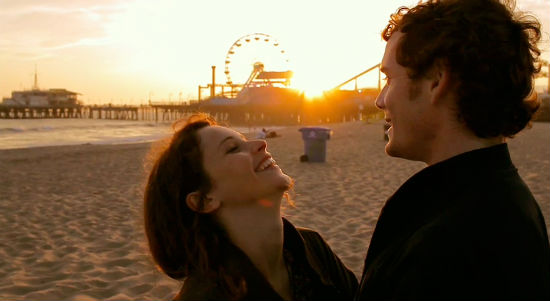
Film Review: Like Crazy (2011)

Anna and Jacob meet in LA where they're both going to college, and they fall in love. The only problem is that Anna's from England. When she overstays her student visa and is barred from coming back to the US, they struggle with keeping their relationship alive across the distance.

The premise of this film is one I appreciated. As I'm gingerly stretching out into traveling I'm meeting great people. Keeping those connections alive, even if they aren't romantic in nature, can be challenging. A friend of mine is currently trying to make a transatlantic relationship work and I've been a sympathetic ear for her as much as possible; our friendship is also a slightly long distance one as she lives a few hours across the country from me. So the subject matter of this movie seemed relevant.
Anton Yelchin and Felicity Jones play the two young leads. We watch them age believably from child-like students to adults developing careers and relationships. I've enjoyed both of these actors in previous roles, notably Yelchin in the new Star Trek movie and Jones in The Tempest and Northanger Abbey. Alex Kingston and Oliver Muirhead appear as Anna's delightful parents who provide a sounding board for the couple's relationship.
In spite of a strong cast and intriguing premise, the film was a bit lackluster. I found it to be missing something emotionally. We keep being presented with evidence of the couple's love for each other through Anna's scrapbooks and Jacob's furniture making, but something doesn't connect.
It seems that the writers Drake Doremus and Ben York Jones wanted to bring realism into the scenes. The speech patterns sound like a transcript of everyday conversations (apparently using some improv on set) which resulted in conversations often lacking eloquence, full of awkward moments, and stammering. Combined with the sometimes random, choppy time lapses and montages, what ended up resonating with me most was the disconnect between the characters. Even when Jacob and Anna are in the same room together, they seem to be an ocean apart. There's something uncomfortable about much of their interaction.
When they're apart they seem to quickly fall in with other lovers, making me doubt their devotion to each other even more. Yet they display jealousy at the thought that the other might be seeing someone else as well. Perhaps that's why the ending of the film leaves us with some uncertainty, it isn't a brick wall happy ending, but it isn't entirely without hope. We're unsure of how they'll end up. I do have applaud the sophisticated, mature way it was ended without crushing or soothing us, showing the audience something a little more difficult, a little more real.
I wanted to like this film and it wasn't terrible, it just didn't strike me the way I had hoped. The romance it revolves around was hard to have faith in. I kept wondering why the characters didn't move on, if they were trying and force something more out of a youthful fling. It was first love, but maybe not permanent love.

Friday, September 28, 2012

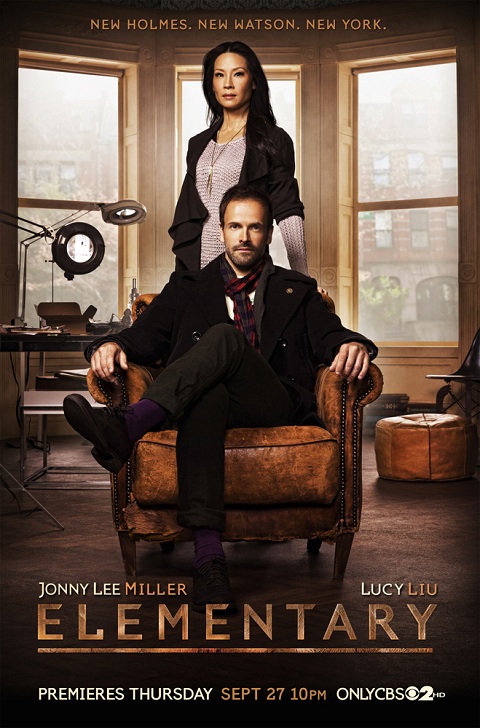
Elementary.... Sherlock Holmes in 21st Century New York

When it was announced that CBS would be doing their own modern take on Sherlock Holmes (after the BBC wouldn't allow them to remake Sherlock) fans of Holmes were startled and alarmed. Especially when it was announced that Watson would be played by Lucy Liu. It certainly goes against tradition.
So was it worth all the kerfuffle?
In some respects no. In last night's pilot of Elementary, Lucy Liu proved herself very adept at being the every man foil to an unhinged detective. As the element people were most worried about, she was a pleasant surprise. From a design point of view, she also had a very good "look." I also don't mind the New York setting. It can work.
I suppose my main criticism of the show thus far (and I realize most network shows need to settle in over the first few episodes) is that it's sort of bland. Johnny Lee Miller's Holmes is an arrogant detective and recovering drug addict. Yes, he may have the capacity to be an interesting character, but he's not yet. Nothing is really screaming "Holmes" about him either. He keeps bees, that was the one token quirk they threw the audience last night. The possibility of Holmes' father is new to the pastiche genre and may have some possibility, but I'm still not convinced by the writing or Miller's portrayal of the character. He doesn't have the mystique or the charisma yet.
The NYPD is also really boring. So far we've seen Captain Gregson who worked with Holmes while he was abroad attached to Scotland Yard. Their history and relationship doesn't really read at this point. Detective Abreu seems like someone Holmes might rub the wrong way. In their first scene, Holmes disproves the Detective's assumptions about a crime scene. Yet, later in the episode he does Holmes' bidding with little trouble. Right now the police are just placeholders, filling a function, not real people with internal lives and the possibility for conflict.
I wish they hadn't advertised this as a Sherlock Holmes adaptation. If they had changed everyone's names, I would have no trouble enjoying it as a new "consulting detective" show on CBS. We could have had a show that pays homage to Holmes in its inspiration instead of a "Sherlock Holmes" show that never quite delivers.
There is a good possibility that the show will find its footing and be quite decent. But nothing so far says it's Sherlock Holmes to me. Sherlock Holmes wouldn't have kinky ladder sex with a prostitute. I also don't believe that he would ever have a "temper tantrum" to the extreme he does in this pilot. His mind is always in control. He may do bizarre things, but it's for a purpose, a master plan. So far, I'm not certain Miller's Holmes is capable of the "long-game," if you will. How will he cope when a Moriarty is eventually introduced?
Some fans are rejoicing the fact that Miller is an attractive and competent actor that they can enjoy in the role for twenty or so episodes per season. Yes it's hard to wait a year and half for each set of three episodes from Sherlock, but they are more than episodes, aren't they? They're really mini-films. "A Study in Pink" held up side by side with this first episode creates a sad comparison. Really, there is no comparison. Elementary is.... HolmesLite. We'll be getting a decent, Sherlock Holmes-ish series in great quantity, but nowhere near the quality and detail of Sherlock.
So will I watch it? Probably. At least unless they do something that's unforgivable to me. It's just an entirely different beast from Sherlock.

Sunday, September 16, 2012

Bill Bryson: The Mother Tongue

The Mother Tongue: English and How it got that Way is a delightful book. Anyone interested in language, etymology, or history will love this book. Anyone vaguely curious about why English can seems so strange or confusing will find it enlightening and amusing.
Bryson works his way through some of the basics of the history of the language: how a bastardized peasant tongue somehow became one of the dominant languages of the world. Some of the sketchier bits of history like "the great vowel shift" are skirted over with good reason: there is no definitive understanding of that strange happening to this day. Dialects, American and British are discussed, as well as how the names of places and people came to be, and also the origins of swear words.
What always rings clear in this book is the fact that language is not a permanent thing. English is strangely malleable, constantly shifting, picking up bits of other languages, and changing. Where some languages have change very little in the past thousand years (so much so, you could read ancient manuscripts with little difficulty), old English is nearly unrecognizable to modern readers. Though Bryson admits English has its failings and that other languages are more expressive or sensible in certain areas, his love of the language is seen on every page. He reminds native speakers that the language they speak is beautiful, expressive, and unique among world languages.
Perhaps he is a little biased in his love of English, and doesn't go into all the textbook definitions. It's not a textbook, and it never feels like one. Overall, it's a book that is both fun to read and will teach you dozens of new things about the English language. Something about Bryson's voice is engaging and personable. You feel like you're chatting with an incredibly smart friend while having a drink together on a lazy Friday night. I'm currently in a Linguistics class at the moment, and I must say, that though The Mother Tongue seems light on the science, it was a fantastic book to read before the class. Nearly all of the topics on our syllabus were touched on by Bryson. I feel much more prepared than going into the class cold.

Thursday, June 28, 2012

Music Review: Scythian, It's Not Too Late

I don't normally do music reviews, but music was my first love. Scythian is a band I've seen play live a dozen or more times. They're extraordinary when doing live shows. It's the only band I've ever seen successfully make their audience do leg kicks in unison. Perhaps they use hypnosis, or perhaps it's the intoxicating strains of the fiddle.
One of the hardest things about a band with so much live charisma is the ability to capture that energy and personality in a studio album. Wisely, the band has released two live albums which are the next best thing to seeing them (though if they come to your neighborhood, I suggest you get to a show). It's Not Too Late is their newest studio album, released just a year after their previous, American Shanty.
It's Not Too Late marks a slight shift in their sound, as they explore the many facets of their musical identity: Celtic, bluegrass, Americana, southern rock, Eastern European gypsy sound, folk, and more. Somehow they blend all these aspects to make a sound that is uniquely Scythian. They've become known in Celtic and folk music circles for their raw and raucous fiddle and guitar sounds that are covered with the dust of the road and the colors of their travels. This album shows us some of the softer side of Scythian; perhaps Scythian in love? The title track of the album, is a gentle song about taking your opportunities to find love. This theme is touched on again in the sweet sentiment of "End of the Street"-- a song about falling a little bit in love while living the gypsy life style of a musician, and that feeling is capped with the penultimate track of the album, the addictive "That Girl." It's a rollicking southern rock song that could have easily been the hot song of the summer thirty or forty years ago. It has a charming sense of nostalgia.
The instrumental tracks on the album show off the traditional Celtic licks of the group with the "Sheldon House Reels," a powerful piece that builds on two fiddles and two guitars. "Halloran's Jig" will definitely tempt you to do some amateurish Irish dancing. The band reached back to their roots with the Ukranian, "Arkan" which takes you another time and place with a sense of tradition captured by its mournful fiddle and masculine chanting.
This has been a transition year for the band, losing one member and gaining two more. Unfortunately the two brothers who form the hub of the band, Alexander and Danylo Fedoryka suffered a personal loss recently as well. This album is dedicated to their late mother who is memorialized in the song, "The Only One."
No doubt, things are changing for the boys of Scythian, they've cut down their touring schedule for 2012 and are maybe developing in some new directions. After about a decade on the road, this shift might be just what they need to breathe new life into their music. They remain one of my favorite groups, especially to watch live. The albums are never the same as experiencing their performance, but their latest offering is solid and has many powerful highlights that emphasize the band's almost chameleon like versatility, but ultimately shows us that in spite of all the variety, it's always all Scythian.

Thursday, June 7, 2012

Review: Best Exotic Marigold Hotel

When a group of retirement age Brits find that their plans for the golden years have been interrupted by finances, they all end up in India at the Best Exotic Marigold Hotel for the Elderly and Beautiful. The hotel is run by Sonny, the youngest in his family, he's desperate to live to the success of his older brothers as well as convince his mother to let him marry his sweetheart, Sunaina. During their stay at the hotel, each of the retirees learns something about themselves and discovers whether or not India is really for them.

The cast of this film is fantastic, in fact it was the main draw of the film for me. Veteran actors and actresses Maggie Smith, Judi Dench, Tom Wilkinson, Bill Nighy, Celia Imrie, and Penelope Wilton lead the cast. Each have their own separate, but intersecting story lines. Overall, the film balances these stories fairly well, giving each actor time to shine. Maggie Smith was a definite highlight in her role as a former nanny who needs a hip replacement. Her journey overcoming her prejudices through a friendship with an untouchable woman who works at the hotel is compelling and funny. Unfortunately we never see much screen time between Smith and Dench. Dev Patel of Slumdog Millionare manages to hold his own with a cast of stage and screen legends as the sometimes self-effacing Sonny.
It was a charming, affable British comedy. Part of the problem was that it was a little too wrapped up in its own humorous charm. The plots were largely predictable, coming to satisfying, but in no way challenging, endings. In a few instances they get very close to hitting on some meaty substance, but don't delve too deeply into it in spite of some promising themes. For a lazy summer afternoon, it's a perfect film to enjoy with your family. There are plenty of funny moments that stay classy for the most part. There's no extreme raunchiness or vulgarity, just the occasional naughty euphemism perhaps. It is witty and the cast has great chemistry with each other.
I would recommend it for those that love British comedies with lots of heart.

Sunday, June 3, 2012

Review: The Particular Sadness of Lemon Cake by Aimee Bender

On the eve of her ninth birthday Rose samples the homemade lemon cake her mother has made and she is overwhelmed. Within the pale yellow slice and chocolate icing, there lurks Rose's mother's sadness and longing. From then on, Rose's sensitivity to the feelings within food only grows. We follow her into her twenties and watch how her special ability can hurt. Rose explores her relationship with her family: her distant father with a phobia of hospitals, her emotional mother, and her sullen older brother.

This book had so much potential. I was primed to fall madly in love with it. Like the beautiful Like Water for Chocolate by Laura Esquivel, it set itself in a realm of magical realism. Magical realism is grounded in the real world, but accepts the possibility of the fantastic in daily life- that the things we feel can manifest themselves tangibly.
The first few chapters were like a sweet little dance, drawing you in, flirting with you. The book had an engaging premise and Bender has a good grasp of language, but she failed to bring in the necessary third element: plot follow-through. The story felt half finished, unresolved. It fizzled out with an anti-climax. There were some other fantastic elements introduced besides Rose's ability, such as a plot line regarding her brother and his mysterious disappearances. Ultimately this fell flat and became disorienting. I thought the discovery of her grandfather's similar ability felt like a sloppy quick fix to her relationship with her father.
As the book drew to a close and a promising romantic plot was abandoned, Rose is finally pushed onto a path with some possibility, but we never have any resolution to her story. There is an attempt to embrace her special skill (which makes normal eating almost impossible to sustain), but the ending feels like an afterthought in many ways.
What's good about this book? The beautiful writing and descriptions. What's not so good? The lack of plot movement and unresolved ending. I would attempt the author again because I think she has a strong voice that I enjoy, and hopefully better develops her story in other books.

Saturday, April 14, 2012

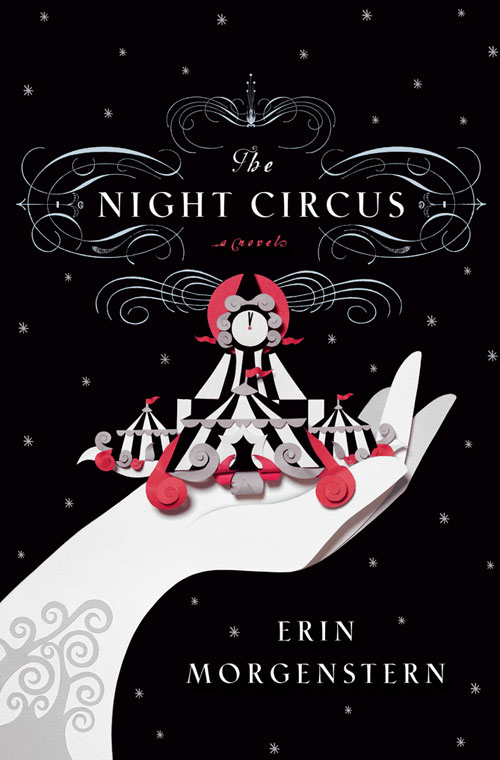
Review: The Night Circus by Erin Morgenstern


"The circus arrives without warning."
So begins one of the biggest fiction hits of last year. The reader is then invited into the intoxicating world of Le Cirque des RĂªves. The circus only opens at nightfall. Everything is painted in black and white, tents are not only places to watch the contortionist and the illusionist, but some tents are like whole other worlds. Step into a garden of ice or wander through a maze of clouds. Behind the circus lurks a historic battle between two magicians as they pit their students against each other on the stage of the circus.
I think that readers who were disappointed by this novel expected it to be an action-packed blockbuster, maybe in the science fiction range of the film The Prestige. No, Night Circus is a deeply layered flight of fancy. You become immersed in the circus and all the players that have become a pawn in the game. It is magical realism in the best sense. Grounded in the real world, the characters create their own encasement of whimsy.
It is a love story, but a love story with unusual stakes. Two students of magic were bound together from an early age, dancing around each other without making contact for years. When they do it becomes clear that they were too perfectly paired, too complementary. Beyond those that live and work within the circus there are those that follow it, feel its tug, the reveurs.
Though not perfect, Night Circus makes for a stunning debut novel. Morgenstern takes time to layer her story with the lives of her characters and the intersections they make. The atmosphere is so rich though, and so cleverly imagined, it will make you want to run away to the circus.

Saturday, February 18, 2012

Review: Professor Moriarty and the Hound of the D'Urbervilles


From the back cover: "Imagine the twisted evil twins of Holmes and Watson
and you have the dangerous duo of Professor James Moriarty- wily, snake-like,
fiercely intelligent, terrifyingly unpredictable- and Sebastian 'Basher' Moran-
violent, politically incorrect, debauched. Together they own London crime,
owning police and criminals alike."


If The Adventures of Sherlock Holmes are well thumbed in your library, you may find it interesting to puruse this collection of the adventures of Professor James Moriarty as told by his right hand, Sebastian Moran.
From their Conduit Street rooms, Moriarty runs a crime syndicate that encompasses all of London and has international connections as well. Moriarty arranges the mathematical crimes and Moran is his trusted gun hand, back from military service after nearly being clawed to death by a tiger which he then killed. The two men have a career of the most creative sort of crimes; from making the mistake of taking Irene Adler as a client, to a most delicious revenge against one of the Prof's former pupils, to the title story which chronicles their own investigation into a cursed family.
Holmes and Watson are boy scouts, comparatively. Moran and Moriarty are vicious, misogynistic, and anarchic, but immensely entertaining. Occasionally crude, but definitely colorful, Moran as our narrator ingratiates himself and by the end of his story is actually almost a sympathetic figure.
The book is divided into seven tales, some of which are stronger than others. "The Red Planet League" stands out as especially clever and humorous. After "The Hound of the D'Urbervilles" story arrives in the middle of the book, there is a slight dip in the story. Perhaps it's because the initial naughty pleasure of the insane concept has waned, or perhaps because we want to see the stakes raised more. However, the final story, "The Problem of the Final Adventure" is worth hanging on for. The raucous tone of the opening tales is subdued, but here's where we see some of that character development, the raising of stakes, and a surprising bit of pathos from our narrator.
Fans of the stories of Arthur Conan Doyle will see plenty of references and parodies from his Holmes tales throughout the novel, as well as some little digs at Doyle's continuity problems (Moran explains that all three Moriarty brothers are named James because their parents liked the name so much). No literature is safe, however. The title story concerns the D'Urberville line, yes, Tom Hardy's D'Urbervilles. Little passing references are also made to Poe's mysteries, Leroux's Phantom of the Opera, and even a nod to H.G. Wells. End notes, some more sarcastic than others will direct you to some of the allusions you may miss.
The treatment of Holmes in the story is a little odd. He makes very little appearance, though of course in the story of Holmes' adventures, neither does Moriarty. Implied off-stage tinkering serves as all the back story for their relationship in both accounts. Moriarty's view of Holmes is so very different than the view an affectionate audience has, that it's a little unsettling. Perhaps author Kim Newman intended it to be. Moran fiercely insists that Holmes was not Moriarty's arch enemy, but another slippery criminal trying to take Moriarty's place, Holmes was just bad timing, the last nail in the coffin of their crumbling criminal empire.
If you love the various incarnations of Moriarty and enjoy a bizarre romp through literature and crime, you should definitely give this book a try. Are the scenarios totally improbable? Yes. Are some stories less gripping than other? Yes. It still may be worth your time though. Sometimes the absurdity really is the point. Your pastiche collection won't be complete without this oddity.

Wednesday, January 18, 2012

Review: The Reichenbach Fall, Sherlock series 2


On Sunday, The Reichenbach Fall, the series 2 finale of Sherlock aired. Based off Doyle's story "The Final Problem" (a title which is referenced several times in the episode), the episode opens with John back at the therapist's office. He tells his therapist he's come back after all this time because his best friend, Sherlock, is dead.
From there we get the story filled out. Sherlock steadily gains more and more media exposure through John's blog and the solving of several high profile cases. John warns him that this might be dangerous. Meanwhile, Moriarty is back with the ultimate plot. He has a computer code that can open any security system. He simultaneously breaks through the security of The Tower of London, The Bank of England, and Pentoville. It's going to be the trial of the century and Sherlock will be the main witness for the prosecution.

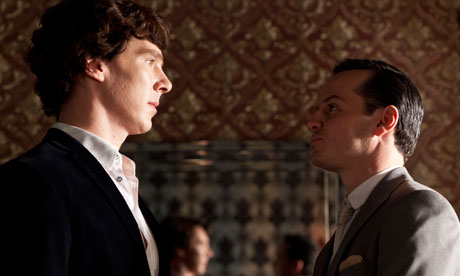
The episode was a fantastic cap for the season. It was great to have more screen time for Andrew Scott as Moriarty. This version of Moriarty is certainly unique, but he's always exciting to watch. His Moriarty is brilliant, unpredictable, and relishes the game so much. He's delicious to watch, and he scenes between Sherlock and Moriarty are extremely powerful. Their verbal chess match towards he end of the episode contains several surprising twists. Scott's versatility comes through and there's a scene about an hour into the episode where he might make you momentarily question your sanity.
This episode lets us see Sherlock at his most desperate. This whole season has been about uncovering his vulnerabilities, finding what's really important to Sherlock and this episode takes that even farther. By the end of the episode you may have to disagree with Sherlock's earlier assessment that "Heroes don't exist, and if they did I wouldn't be one of them."
It was Martin Freeman's performance, however, that really made the episode. Give that man another BAFTA. His ability to emote, but emote in a controlled way that would be appropriate for John Watson, the soldier and doctor, is so subtle and deft. It's heartbreaking to see him in pain, more heartbreaking when he tries to be strong about it.

The series as a whole definitely lived up to expectations. The success of the first season gave the writers more license to push boundaries and experiment, some experiments were more successful than others, but they were always entertaining.
The direction and overall cinematography put this leagues above any other show on television. The transitions between scenes are always visually interesting and cleverly done. The creation of atmosphere, whether in on the moors, or in the middle of London, grab hold of the viewer. They found even more interesting ways to visualize Sherlock's thought process this season as well-- the "Mind Palace" sequence from Hound was definitely a highlight, and possibly a new dance move.
The end doesn't leave on as painful a cliff hanger as the first season, but will leave fans eager for more, and indeed, a third season has been commissioned. Unfortunately it won't arrive until 2013 due to the filming of The Hobbit which Martin Freeman stars in with Benedict Cumberbatch supporting as Smaug.

Saturday, January 14, 2012

A Moveable Feast

Sorry it's taken me so long to get around to writing about this piece. I checked it out of the local library last month and read a few chapters each week in the Laundromat.
A Moveable Feast is Ernest Hemingway's chronicle of his life as a young writer in Paris. He meandered between cafes and friends' homes, staying in bare bones accommodations with his wife Hadley. Many other writers of the time figure into his account, Gertrude Stein, Ford Maddox Ford, Ezra Pound, F. Scott Fitzgerald and others. Each person sketched in detail sometimes brutal detail. Fitzgerald especially comes off as a bit of a naive fool, best illustrated in this infamous passage.
I love many of Hemingway's short stories, but his novels tend to be a little hard for me to connect to and read all the way through. However, I loved this memoir. Its stark prose was littered with surprising moments of poetry. This is one of my favorite passages from early in the book:


"All of the sadness of the city came suddenly with the first cold rains of winter, and there were no more tops to the high white houses as you walked but only the wet blackness of the street and the closed doors of the small shops, the herb sellers, the stationary and newspaper shops, the midwife— second class—and the hotel where Verlaine had died where I had a room on the top floor where I worked.”


Of course, reading about Hemingway's struggles as a young writer is reassuring to this young writer. All his desire to write "one true sentence," to publish, to be a good writer are something I can connect to in my own journey. Even when set backs (like losing a suitcase full of stories there were no other copies of) didn't deter him from his quest. It makes me want to go back to my "Complete Short Stories of Ernest Hemingway" and reread all of his early works that are alluded to in the memoir.
So definitely give this one a read, even if you don't always enjoy Hemingway, this is not to be missed

Friday, January 13, 2012

Review: Sherlock "The Hounds of Baskerville"


In a nod to a lesser known, lesser adapted Holmes story "Black Peter," the episode opens with Sherlock arriving back at the flat covered in blood and carrying a harpoon he used to spear a pig that morning. He had to take the tube home "None of the cabs would have me." With that slightly gorey start, writer Mark Gatiss takes us on a horrific adventure into Dartmoor on the tail of a giant hound. Henry Knight arrives on the morning train asking for Sherlock and John to help him. Twenty years before, his father was ripped apart in front of him by what seemed to be demon hound- possibly an escaped genetic experiment from Baskerville, a government testing facility nearby.
The episode did a great job of inverting some of the expectations that Holmes fans would have for an adaptation of Hound of the Baskervilles. No longer set in a creepy country home haunted by a curse, it takes the story to that modern haunted house, a laboratory where anything could lurk. Many moments of pure psychological terror were in store for all of the characters, even Sherlock our cool logictician. How can Holmes deal with fear and doubt, the inability to trust his own senses? How can Watson deal with such a Holmes?
Our two leads had an opportunity to explore a new aspect of their relationship. One where Sherlock tests certain limits. More importantly, we see John hurt by Sherlock when he insists in one taut scene, "I don't have friends!" By the end though, Sherlock has to relent that he doesn't have friends, just one friend.
Though the episode pays homage to Doyle's original creation, it steps boldly into new territory, allowing itself to differ from the original. Hound is the most adapted Sherlock Holmes story, one that carries with it a lot of baggage. Gatiss sheds much of that baggage by reinventing several aspects of the story and giving fans something fresh and original, something they won't be as familiar with.
Overall, it was a very strong episode. It continues on the momentum created by the raucous first episode and keeps giving us something new from our characters, which can be hard when they are so established in the public consciousness.

*Here there be spoilers:*
One small issue I did have with episode was how the characters were exposed to the hallucinogen. It wasn't in the sugar as Sherlock originally assumed, so how did it get into John's system? Before he goes into the lab, there is a pipe spurting steam and we see the passage fill with it a bit, but would a top government lab allow drugs to freely flow in its laboratories? Unless we assume that Franklin was slipping what was usually a small amount of the drug to his colleagues. That does seem like a plot hole that could use some patching.
The ending was an interesting gear up to next week's episode. Mycroft has clearly made good on his vow at the end of "Scandal" to give Moriarty some of his attention, but since he doesn't get his hands dirty, is forced to let him go. The eerie graffiti all over the holding room shows us that Moriarty has reached a new level of obsession. This version of Moriarty has been a little hard for some to swallow, but I think it's interesting. Why do the same old thing over again?
This Moriarty is a little younger, a little more childlike (which makes him a good counterpoint to our younger, sometimes immature Sherlock). He is clearly intelligent, running a huge criminal enterprise, but Sherlock has become his one obsession. Maybe it's the crack in his lens, maybe his obsession will make him vulnerable? We'll see this Sunday.

Tuesday, January 10, 2012

Quick Review: One Good Turn by Kate Atkinson

I read this over week ago, but haven't had time to review until now.
At the end of Case Histories Jackson Brodie ran off to France with his inheritance for an early retirement. One Good Turn sees him back in the UK two years later. He arrives in Edinburgh for the festival to see his girlfriend Julia in a play and finds himself in the middle of police investigations and in the cross-hairs of Louise, a no-nonsense female officer.
The plot sees several seemingly unrelated crimes: a fit of road rage, the body of a girl washed up on the beach, and the unscrupulous practices of a business man, but they all prove to be connected. Atkinson richly illustrates the lives of these characters, making each one come alive, not just Jackson. One of the best characters is Martin, a soft-boiled crime writer who is hapless, but sympathetic. Atkinson clearly has fun writing passages from Martin's formulaic stories. Gloria the middle aged wife and Tatiana "Jojo" the dominatrix form an interesting alliance to find their own brand of justice. The introduction of Louise as a match for Jackson was a good move as well, I hope that's developed more in the next book. I never liked Julia as his romantic interest.
This is a rare example of the sequel being superior to the original. Atkinson improves on her ability to balance multiple stories and bring them all back to Jackson, the linchpin. The way all the cases end up intersecting is creative and intriguing. She makes you interested in all their lives, even when they make mistakes, even when they break laws, they still have your interest, your sympathy. Rather than the unrelated stories of Case Histories, One Good Turn brings everything together to make a more cohesive story.

Friday, January 6, 2012

Review: Sherlock "A Scandal in Belgravia"


After almost a year and a half, series two of Sherlock has finally arrived. The first episode quickly ties up last years cliff-hanger in a comical, yet chilling scene. It's a little abrupt, but the episode has bigger things to get to, specifically: Irene Adler.
Steve Moffat's version of the only woman to ever outsmart Holmes has stirred up a lot of controversy. Without giving too much away for those of you who haven't seen it yet, I can say that yes, she is different than Doyle's original, but I don't think that's necessarily a bad thing. Much of the backlash comes from fans claiming that this Adler is too sexualized. The character is a dominatrix in this retelling, one who gathers sensitive secrets on her camera phone from her illustrious clients. When she first meets Sherlock, she walks into the room wearing high heels and blood red lipstick.
Clearly this was a bold choice. This episode and the handling of Adler weren't perfect, but I will make a small defense of this adaptation. The original character was an opera singer who travelled the world living by her wits and was most likely the full-fledged mistress of the King of Bohemia. She was a very racy character in her day. Stage performers were seen as loose women. Having her be an opera singer who was the arm candy of some politico wouldn't have as much impact in a modern setting. Her nudity isn't used to make her an object of desire, or to make her helpless. She reverse to her nudity as being her "battle" attire. It's something that makes her powerful by making Sherlock and John uncomfortable.
As far as her being reduced to a sex object, what makes her an opponent to Holmes, what makes her someone he is (perhaps) interested, is her brain. He can't read her, she surprises him and manages to figure out the solution to one of his cases. Their relationship is very interesting to see develop. Cumberbatch does a great job of making Holmes just vulnerable enough, without ever revealing too much emotion. He and Adler circle each other, both admiring the other, but at cross purposes. It is certainly not a love story, but it introduces the feasibility of a different kind of relationship for Sherlock Holmes without taking him in a romantic direction that would be out of character.
Mycroft was much more developed in this episode as well. His role in the government and his relationship with his younger brother. There are several very telling moments between the Holmes brothers within the episode. Of course Martin Freeman's John is incandescent as usual. It was a fairly John-light episode, but he and Cumberbatch had many moments to show the way that Sherlock and John's relationship has continued to develop. Una Stubbs, as Mrs. Hudson, appeared more in this episode, showing her maternal relationship with the boys-- especially Sherlock.
Overall, it was a solid episode. Plenty of great canon references, especially at the beginning of the episode with a montage of cases for Sherlock and John. A few very funny scenes, but some dark moments as well. Not to mention, several twists that may surprise some viewers and keeps you interested.
To end with a John quote: "We solve crimes, I blog about it, he forgets his pants. I wouldn't hold on to too much hope."

Wednesday, January 4, 2012

2010 An Obligatory Review

Oh, I have to. Even if it's only a new year according to our flawed solar calender (just saying, if we followed a lunar calender we could have thirteen 28 day months which would make a lot more sense).
So here are some ways I'll remember 2010:
1. The year of technological horror. I had one computer cord die on me and have to be replaced, then the computer itself died shortly after I replaced the cord. My flash-drive suddenly ceased functioning, then I got a very determined piece of Malware infested in my new computer in time for midterms. Then, right after finals my computer started acting up. Last week then, the Malware came back. So my whole hard drive had to be wiped. Yes, I just got it back today.
2. The year I gave Dickens another try. And you know, I found it wasn't bad. I rather enjoyed Dombey and Son. It was also perfect timing for my honors course in which we read The Mystery of Edwin Drood and wrote our own endings. My version (not surprisingly) was described by my professor as a bit "film noir." It was a lot of fun.
3. The year of rejection. For the first time, I started actively submitting my work to lit journals and querying agents and editors. I had done little touches of freelancing, but I had never submitted so much before. Ergo, I've never been rejected so much before. Dipping my toes into the publishing world was an overwhelming experience. I may have had a breakdown (or two) and reconsidered my choice to be a writer. Overall though, I learned a lot, and hope to start round two later this year.
4. The year of detective stories. Not just my own, though they have been constantly on my work table. I started a very determined course of education; I began an intensive study of the genre. When I looked back over the list of books I read, at least half were mysteries. I brushed up on my Agatha Christie as well as more contemporary offerings. I watched a good many mystery programs as well, the BBC's Luther being one of my favorites (though nothing can dethrone Sherlock of course). Though some stories have spun me around quite a bit, I've also realized that I'm a fairly hard reader to surprise. I'm fairly good at predicting plot twists. When I'm reading Doyle, it's always an ego boost if I can solve the crime before or at the same time as Holmes.
5. The year of Rory Williams. Well, I certainly appreciated him all year long and am going to miss him when he leaves next season. I think he's probably my favorite Doctor Who companion of all time.

Monday, December 26, 2011

The Weed that Strings the Hangman's Bag by Alan Bradley

Flavia de Luce, girl chemist with a possibly unhealthy interest in death is on the case again. In this sequel to The Sweetness at the Bottom of the Pie, a puppet show run by the charismatic and crippled by polio Rupert comes to town. His assistant Nialla has been placed in a desperate position.
When Rupert ends up dead, Flavia is left to untangle the strings of this mystery. Rupert may be more than just a passerby, his history and the history of the inhabitants of Bishop Lacy prove to be tangled together. The mysterious death of a village boy, the mad woman in the woods, and secret liaisons all conspire to make a puzzle for Flavia to solve.

I very much enjoyed The Sweetness at the Bottom of the Pie and was interested in seeing how Bradley would follow it up. He continues to explore Flavia's unique skills and talents. We gain insight into her thought process and her talent with chemical equations. Also though, Bradley expands on her emotional life as well in this volume. Her anxiety over her relationship with her sisters and her questions about the mother she never knew are touched on.
Some of the Bishop Lacey residents of the first novel appear again, but we are introduced to other locals who each help Flavia piece together the solutions to the Rupert's death as well as a death from half a decade before.
Though perhaps, lacking some of the dramatic tension of the first novel, it's still a fun read. Bradley's chapters move quickly, each one fairly short and moving. There are some satisfying twists that may come as a surprise. The solution to the mystery, however left me with mixed feelings, especially over how the murderer should be punished.
The Weed that Strings the Hangman's Bag is a fun, quick read that takes you back into the world of Flavia de Luce, a charismatic, but flawed and surprising believable young girl with remarkable skills. The third book A Red Herring Without Mustard will go on my TBR list. Sequels don't always live up to the quality of the first, but this novel came fairly close.

Thursday, December 22, 2011

The Secret History by Donna Tartt

The novel opens with Richard, our narrator and protagonist thinking back on the murder he and his friends committed back in college. From there we go back to how this story began, making this a sort of inverted murder mystery. We know the victim, we know the killers, now we need to find out why.
At a small college in New England, a select group of students study the Classics with Julian, a charismatic professor who is well traveled and well loved by his students. Richard, newly transferred from California with some Greek study in his background wants to join the class, but has to be accepted by Julian personally. When he finally is, he immediately begins to form bonds with Julian's students.
There's Henry, a genius that seems to live more in the world of the classics than in real life. Charles and Camilla are the twins, they are very close and very secretive. Frances, a sensitive young man with access to his aunt's country home is also among the group. And finally, there's Edmund "Bunny" Corcoran. His family maintains an air aristocracy, but appear to be broke, equipping their son with nothing but skills at mooching off of everyone else and a crude sense of humor.
We learn in the first pages that Bunny is the murder victim. After that we go back and get the story about secrets, ancient rituals, and desperation that lead to his demise.

Overall, it's a decent story. In spite of the obvious tension within the story, there were many sections of the book that simply could not keep my attention. Passages meandered and seemed as listless as its characters after a night of bacchanals. Yes, its college student characters are constantly (infuriatingly) drunk or high, especially Richard, the narrator who wanders around getting drunk and doing cocaine for an alarmingly large amount of the time.
It's true that these are young people, and young people tend to experiment, but it seems excessive in Tartt's prose. I also began to wonder why this group of students was considered so elite, other than Henry, there was little to illustrate any impressive aptitude from them.
The novel was structured after a Greek tragedy. Early on Tartt brings up the elements of fate and the possession of a fatal flaw. In a way, looking at a modern situation through a lens of ancient tragedy can work. There is a fatal flaw, there is a fall, there is a noble sacrifice, and there is a sense of repayment and justice in the end.
Tartt is moderately successful at creating this tragic world. Richard serves as our messenger (as every good Greek play should have) who tells us how this tragedy befell our heroes and how they had to pay for it. It wasn't a bad novel. If you enjoy Greek tragedy and murder mysteries, you may find something of interest here. However, it makes sense that this was Tartt's first novel. She shows that she has talent, but she is not entirely successful with her execution.
This is a good novel to compare with Carol Goodman's Lake of Dead Languages which I reviewed a few months ago, as it deals with many similar themes. Although also flawed, I prefer Goodman's novel because of its taut, poetic language.

Saturday, November 26, 2011

Possession: The Book vs. The Film


Possession is a romantic novel that traces the love affair between two Victorian poets as well as the story of the modern academics piecing together the trail of letters they left behind. The novel is beautiful, full of the lush language A.S. Byatt was famous for. Though, there are some long passages of poetry that seem a little indulgent and unnecessary, you gradually get more and more drawn into the story of the Victorians, Randolph Henry Ash and Christabel LaMotte.
I saw the 2002 film last night with starred Gweneth Paltrow and Aaron Eckhart as Maud and Roland, the modern academics turned historical detectives. Jeremy Northam and Jennifer Ehle play Ash and LaMotte.
Of course the film makes many cuts so that it can fit in a 1 hour and 40 minute time slot. They trim down many things (like some of the epic poems) that don't effect the story too much, but the film seemed to be missing something deeper. The character of Roland, especially seems underdeveloped. Everything seems to happen very quickly and some of the slower, more character driven moments from the book are missing.
Filmmaker and playwright Neil LaBute does tap into a few highly emotional moments which came as a surprise to me. His plays are often rather cool and cynical, but he found his romantic side while working on this screenplay.
Even though it's not my favorite of Byatt's novel, it is certainly worth the reading, even if you've seen the film. If you've read the book, but haven't seen the movie, it's nice to see the story brought to life, but you may have the strange sensation of missing the characters you know from the book. As with nearly any book to film, the book is better, but it was a decent adaptation. Still interesting, intelligent, and romantic. It will never be the way I saw it in my head, of course, but that's always the problem with adaptations.

Saturday, November 12, 2011

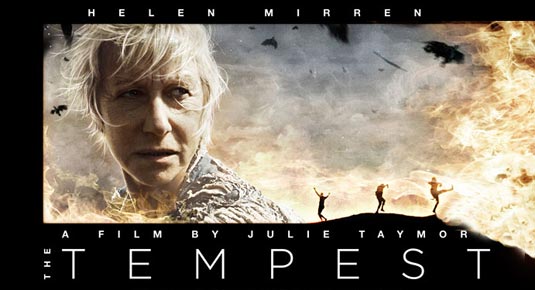
The Tempest (2010)


I finally had a chance to see Julie Taymor's adaptation of William Shakespeare's The Tempest. Taymor has previously adapted Shakespeare for the screen with Titus, her 1999 adaptation of the gory revenge tragedy, Titus Andronicus.
The first noticeable change Taymor makes to Shakespeare's play is that of making the dethroned Duke and part time sorcerer Prospero a woman, Prospera, played by Helen Mirren. People have complained about this, "But this doesn't fit the thesis I wrote about gender roles in The Tempest." However, Taymor wasn't writing a thesis, she was looking at the text with a fresh set of eyes. Mirren is incandescent in the role, full of rage and sorrow.
The rest of the casting is fantastic as well, Ben Whishaw as Ariel and Felicity Jones as Miranda stand out especially. Russell Brand appears as Trinculo, a jester sort of role. He plays Trinculo as Russell Brand, if you don't find him particularly funny, you won't enjoy his scenes very much. In my opinion, he was the one low point in the casting.
Djinmom Hounsou's portrayal of Caliban, like Helen Mirren's Prospera, add new shading to the roles and the play over all. In moments between Prospera and Caliban the sense of imperialism or western colonialism in general seems to be an undertone; the ruling invader speaking to the native, holding power over them. The role of Prospero as a woman brought in the idea the undermining of women's inheritance and legal power and, of course, the witch trials common of the era.
As usual, Taymor's visuals are stunning and artistic. Whishaw's Ariel, the airy spirit, transforms through many of the scenes. From a sheer, snowy white figure able to split himself into several portions, to a terrifying black crow, glistening and winged hovering over the King and his men, driving them mad, each scene presents a new visual landscape which Whishaw and Taymor fully embody.
Toward then end, some of the surreal visuals of the hell hounds chasing Stephano, Trinculo, and Caliban looks vaguely video game like. As one of Shakespeare's later comedies, it is very dark and Taymor struggles to bring out the moments of comedy from within the play with such visuals as well as a very modern sounding musical score under these parts. It is difficult for her to capture what is humorous about these characters in this sublot on film.
In typical Taymor fashion, nothing is completely straight forward. Though the costumes of the nobles that are shipwrecked on the island are grounded in the 17th century, there is a gothic, punk-rock feel. All of their doublets are black festooned with zippers and metal. The belts and boots also have buckles and marks that would make them more appropriate for the grunge movement than the late Elizabethan era. Her costumes are like wink to the audience, reinforcing her point; it's Shakespeare, but filtered through a modern lens.
Shakespeare is different from most literature you probably read in school. It is also (and in my opinion, primarily) theatre. Literature is a more stagnant art form, but theatre is constantly moving and shaping and being collaborated on. If you aren't going to add anything new to the conversation, why bother directing Shakespeare? Taymor is always brave and always willing to experiment which makes her a director worth watching. Some of her experiments are more successful than others, but The Tempest represents mostly success.

Tuesday, October 25, 2011

BBC's The Hour


I was down with a fever and swollen glands last week, so to pass the time I immersed myself in the BBC series The Hour.
It surprised me that I hadn't heard about it sooner, it's a fantastic series. With all the Mad Men fever, more and more mid-century set dramas keep popping up. However, most of these dramas (Mad Men included) seem a little caught up in the costumes and the time period. The Hour makes the 50s seem immediate and fresh.
The struggle of BBC journalists amidst the cold war is full of moments of suspenseful drama. We follow Freddie (Ben Whishaw) as he decodes and unravels the involvement of MI6 with the death of a childhood friend. The reporters and staff of the program must also fight to deliver the news truthfully in spite of blockades and censorship from the government.
The cast is phenomenal. Romola Garai plays Bel, the producer of the news show called "The Hour." Though she inevitably faces some sexism, her character is not defined by it. She is tough, but has moments of self-doubt and the very common fear of becoming her mother. Her friendship with Freddie is one that shows a softer, more laid back side to Bel. Ben Whishaw's Freddie makes a compelling leading man. His earnest, determined search for the truth shows his strength, but he has moments of immaturity and unkindness, especially with Hector, the anchorman and his romantic rival for Bel played by Dominic West. West layers what could simply a "pretty boy" sort of character with surprising depths. Excellent supporting roles played by Anna Chancellor, Lisa Greenwood, Josh McGuire and Anton Lesser round out the newsroom crew.
The writers are even more responsible than the actors for the layering of the characters. With each episode we get to know the characters more, what they want, where they are vulnerable, but it all arises naturally from within the conflicts and decisions they are involved with.
Overall, I was very impressed by the series. I hope there will be a second season and more to enjoy from writer, Abi Morgan, and the cast.

Wednesday, October 19, 2011

The Lake of Dead Languages by Carol Goodman

Jane returns to Heart Lake, the boarding school she won a scholarship to as a freshman in high school. After divorcing her husband, she gets a job at the school teaching Latin, but her past won't let her go.
Her senior year, her two roommates, Deidre and Lucy, as well as Lucy's brother, killed themselves. The lake holds so many memories for Jane, most of them bad. When the events from her senior year seem to be occurring again, Jane is the only person that can unravel the threads linking the past to the present.

This book is eerily similar to Goodman's Arcadia Falls, but at the same time, a much better book. The setting of a boarding school with its atmospheric woods and equal parts beauty and danger, are the setting for both these novels.
The Lake of Dead Languages is a highly atmospheric book with a suspenseful plot. However, the suspense dwindles around the middle of the book where it becomes obvious what all the plot twists will be. There are very few surprises in the latter part of the book. One keeps reading just to make sure they are correct and hoping for a new turn that makes it exciting again. Unfortunately, that doesn't happen.
Goodman assumes the sophistication of her audience, peppering it with classical allusions, thoughtful comparisons, and plenty of Latin phrases. This is refreshing when compared to authors who write down to their audiences with 6th grade vocabulary. Some of the comparisons of within the story to the writings of Ovid and others do seem a little indulgent.
I would still recommend it for fans of modern gothic literature. Part of me wants to read more of Goodman's writing because of her lushness of language. The other part is afraid I'll be stuck in the same story for the third time.