Showing posts with label mystery. Show all posts

Saturday, December 22, 2012

Brevity is the Soul of Wit: In Defense of Slim Novels

I see more agonizing over how long a novel "should be" than I feel is needed. My mystery novel (shiny new draft recently completed) clocks in at about 53k words. Short, but still above the prescribed 50k it must be to be considered a novel.
I suppose I find it frustrating when I see blog posts telling me that suspense and mystery novels should range 65k to 80k. Why? Not all agents and publishers adhere to these guidelines strictly, but it's still worrying to think that others may be discouraged by my manuscript length. Many classic mysteries like And Then There Were None, by Agatha Christie and Hound of the Baskervilles wouldn't make that 65k requirement.
I think much depends on the author's style. Do they luxuriate over scenery or stay with a starker viewpoint? I personally write dialogue heavy pieces, allowing character and plot to explain itself in interactions between the characters. I simply prefer that way of conveying information to the audience (probably leftover from all the time I spent doing theatre and working with scripts).
I think many of us can agree that quantity doesn't automatically equal quality in a first novel. In creative writing classes, exercises where you shave away all your adjectives and exposition often prove liberating. I've been in my share of creative writing workshops where a little trimming did wonders. Young writers especially have a tendency to "clear their throats" at the beginning of pieces. Their first paragraph, stanza, or chapter can sometimes be eliminated entirely. I suppose I'm trying to write as tightly as possible. I don't want to give myself room to clear my throat.
That's not to say that many breathtaking novels haven't soared over 100k words. Some stories simply call for longer books if they have complex plots spanning over long periods of time or the author has to build an entirely new world on the page (in the case of fantasy).
Through subsequent edits, I may bulk out some characters or subplots of my novel and add a few thousand words. I just don't see the point in adding bulk for the sake of it.
Never write just for the sake of meeting a word count. Unless you're just having fun with NaNoWriMo. Or meeting a requirement for one of those creative writing classes. Even then, I feel like you should be working towards something with those words.
I'm sure that as readers, we've been equally touched by a slim novel (Ahem-- The Great Gatsby) as we have by a thicker text at some point in our lives. I suppose I'm trying to convince myself that ultimately it won't matter so much. That no one will try to pigeonhole me to YA fiction if I can't break 60k. That savvy literary agents know it doesn't really matter.
It's just hard writing between the standards. I wrote a novella last winter that I'm really proud of. It was my grand experiment trying to write layers of plot and character to follow a musical pattern (with refrains, variations, and harmonies). I love that piece, but I'm not sure what to do with it.


Monday, December 17, 2012

Shiny New Drafts and Breathing Space

The semester is officially 100% finished. I've just sent off the shiny new draft of my mystery novel to my favorite reader: my English professor. She read my previous draft and gave me some very enthusiastic and thoughtful feedback.
So now I'm working on my Oxford story as well as the historical fiction piece I started in the spring. Aha, yes those of you who are keeping track would be correct, the count is now up to three major projects. That's right, I've been secretly working on a piece set at the turn of the century. Didn't know about that, did you? Enigmatic me. I suppose the piece is both historical fiction and crime fiction, but not in the usual way.
However, for the next few days, I've decided to take a much needed breather. I have serious end of semester fatigue. I haven't even been able to do any lengthy reading. Light reading, long walks, hot tea, and a Scrabble evening with my friend: that's what I need. And this week, that is what I shall endeavor to make time for. Then back to the manuscripts. Also back to my ever-growing reading list.
In my endeavor to write the kind of books I like to read, I've been trying to read as much literature that falls within my genres as possible. I've been working my way through piles of contemporary and classic crime and suspense literature. Then I began amassing Oxford based literature-- a more herculean task than I originally suspected. Of course this is also nerve wracking when seeing exquisite examples of writing and noting how crowded your genre is. Though, to be honest, most genres are crowded these days.
So, here's where I try to make some brain space.
Enjoy some music by The National.

Friday, September 28, 2012

Elementary.... Sherlock Holmes in 21st Century New York

When it was announced that CBS would be doing their own modern take on Sherlock Holmes (after the BBC wouldn't allow them to remake Sherlock) fans of Holmes were startled and alarmed. Especially when it was announced that Watson would be played by Lucy Liu. It certainly goes against tradition.
So was it worth all the kerfuffle?
In some respects no. In last night's pilot of Elementary, Lucy Liu proved herself very adept at being the every man foil to an unhinged detective. As the element people were most worried about, she was a pleasant surprise. From a design point of view, she also had a very good "look." I also don't mind the New York setting. It can work.
I suppose my main criticism of the show thus far (and I realize most network shows need to settle in over the first few episodes) is that it's sort of bland. Johnny Lee Miller's Holmes is an arrogant detective and recovering drug addict. Yes, he may have the capacity to be an interesting character, but he's not yet. Nothing is really screaming "Holmes" about him either. He keeps bees, that was the one token quirk they threw the audience last night. The possibility of Holmes' father is new to the pastiche genre and may have some possibility, but I'm still not convinced by the writing or Miller's portrayal of the character. He doesn't have the mystique or the charisma yet.
The NYPD is also really boring. So far we've seen Captain Gregson who worked with Holmes while he was abroad attached to Scotland Yard. Their history and relationship doesn't really read at this point. Detective Abreu seems like someone Holmes might rub the wrong way. In their first scene, Holmes disproves the Detective's assumptions about a crime scene. Yet, later in the episode he does Holmes' bidding with little trouble. Right now the police are just placeholders, filling a function, not real people with internal lives and the possibility for conflict.
I wish they hadn't advertised this as a Sherlock Holmes adaptation. If they had changed everyone's names, I would have no trouble enjoying it as a new "consulting detective" show on CBS. We could have had a show that pays homage to Holmes in its inspiration instead of a "Sherlock Holmes" show that never quite delivers.
There is a good possibility that the show will find its footing and be quite decent. But nothing so far says it's Sherlock Holmes to me. Sherlock Holmes wouldn't have kinky ladder sex with a prostitute. I also don't believe that he would ever have a "temper tantrum" to the extreme he does in this pilot. His mind is always in control. He may do bizarre things, but it's for a purpose, a master plan. So far, I'm not certain Miller's Holmes is capable of the "long-game," if you will. How will he cope when a Moriarty is eventually introduced?
Some fans are rejoicing the fact that Miller is an attractive and competent actor that they can enjoy in the role for twenty or so episodes per season. Yes it's hard to wait a year and half for each set of three episodes from Sherlock, but they are more than episodes, aren't they? They're really mini-films. "A Study in Pink" held up side by side with this first episode creates a sad comparison. Really, there is no comparison. Elementary is.... HolmesLite. We'll be getting a decent, Sherlock Holmes-ish series in great quantity, but nowhere near the quality and detail of Sherlock.
So will I watch it? Probably. At least unless they do something that's unforgivable to me. It's just an entirely different beast from Sherlock.

Sunday, May 6, 2012

Coming to an End and a Beginning

I'm officially done with classes. All that is left is one final and I am free for the summer. Oxford is less than three months away. I have to book my flight (almost immediately), get a new suitcase, and start working my way through the reading list they sent me. I'm not going to lie, I've been using my forthcoming trip to justify marathoning episodes of Inspector Lewis. Hey, it's set in Oxford and I believe much of it is filmed there.
I also tried a European style beer with a higher alcohol content the other night and ended up with the worst heartburn of my life. I'm am not fit for pub crawls apparently. I'm fine on wine and American beer, but not European beer. Alas. At least there is little chance of my becoming a drunken wastrel ambling about England and neglecting my studies. There was never much chance of that though. Many of my friends couldn't seem to understand why I was going abroad over the summer to actually study. ("You're actually planning to spend your time in classes?")
Last week I surrendered my manuscript to my advisor. Already I'm thinking of the million little and not so little things I need to change about it once it's back in my hands. Before I turned it in I gave it a once over for major mistakes and fixed my chapter numbers (they got a little wonky along the way). Now I'm thinking back over that reading and simply analyzing how my story works out, trying to put myself in the reader's point of view. I actually feel embarassed by one plot device now that I've thought about it. It needs to go and be replace by something that uses my character's brains more than her feminine wiles.
Ugh, I wrote it under the influence of insomnia and deadlines, that is my only defense. I feel like she comes off as too manipulative and calculating, but also too confident and experienced in her dealings with the opposite sex. It's just all wrong. I hope my Professor isn't totally put off by it.

Monday, April 30, 2012

Musical Inspiration

So I have finished my novel, or at least this draft of it. Or at least I'm done tinkering with it... for now. Or really, I'm just stopping because I have to turn it in Tuesday. Well, you get the picture. I think it's at a pretty good place. To celebrate, I've compiled a playlist which I will share with all of you.
Basically it's comprised of songs that I find inspirational Maybe the lyrics suit a character or scene or the sound is just atmospheric. Maybe I could see it in the soundtrack of the future series my books will obviously be turned into by a collaboration of HBO and the BBC. Right. Enjoy.


Get a playlist! Standalone player Get Ringtones

Saturday, February 18, 2012

Review: Professor Moriarty and the Hound of the D'Urbervilles


From the back cover: "Imagine the twisted evil twins of Holmes and Watson
and you have the dangerous duo of Professor James Moriarty- wily, snake-like,
fiercely intelligent, terrifyingly unpredictable- and Sebastian 'Basher' Moran-
violent, politically incorrect, debauched. Together they own London crime,
owning police and criminals alike."


If The Adventures of Sherlock Holmes are well thumbed in your library, you may find it interesting to puruse this collection of the adventures of Professor James Moriarty as told by his right hand, Sebastian Moran.
From their Conduit Street rooms, Moriarty runs a crime syndicate that encompasses all of London and has international connections as well. Moriarty arranges the mathematical crimes and Moran is his trusted gun hand, back from military service after nearly being clawed to death by a tiger which he then killed. The two men have a career of the most creative sort of crimes; from making the mistake of taking Irene Adler as a client, to a most delicious revenge against one of the Prof's former pupils, to the title story which chronicles their own investigation into a cursed family.
Holmes and Watson are boy scouts, comparatively. Moran and Moriarty are vicious, misogynistic, and anarchic, but immensely entertaining. Occasionally crude, but definitely colorful, Moran as our narrator ingratiates himself and by the end of his story is actually almost a sympathetic figure.
The book is divided into seven tales, some of which are stronger than others. "The Red Planet League" stands out as especially clever and humorous. After "The Hound of the D'Urbervilles" story arrives in the middle of the book, there is a slight dip in the story. Perhaps it's because the initial naughty pleasure of the insane concept has waned, or perhaps because we want to see the stakes raised more. However, the final story, "The Problem of the Final Adventure" is worth hanging on for. The raucous tone of the opening tales is subdued, but here's where we see some of that character development, the raising of stakes, and a surprising bit of pathos from our narrator.
Fans of the stories of Arthur Conan Doyle will see plenty of references and parodies from his Holmes tales throughout the novel, as well as some little digs at Doyle's continuity problems (Moran explains that all three Moriarty brothers are named James because their parents liked the name so much). No literature is safe, however. The title story concerns the D'Urberville line, yes, Tom Hardy's D'Urbervilles. Little passing references are also made to Poe's mysteries, Leroux's Phantom of the Opera, and even a nod to H.G. Wells. End notes, some more sarcastic than others will direct you to some of the allusions you may miss.
The treatment of Holmes in the story is a little odd. He makes very little appearance, though of course in the story of Holmes' adventures, neither does Moriarty. Implied off-stage tinkering serves as all the back story for their relationship in both accounts. Moriarty's view of Holmes is so very different than the view an affectionate audience has, that it's a little unsettling. Perhaps author Kim Newman intended it to be. Moran fiercely insists that Holmes was not Moriarty's arch enemy, but another slippery criminal trying to take Moriarty's place, Holmes was just bad timing, the last nail in the coffin of their crumbling criminal empire.
If you love the various incarnations of Moriarty and enjoy a bizarre romp through literature and crime, you should definitely give this book a try. Are the scenarios totally improbable? Yes. Are some stories less gripping than other? Yes. It still may be worth your time though. Sometimes the absurdity really is the point. Your pastiche collection won't be complete without this oddity.

Friday, January 27, 2012

Solving the Mystery Genre: Independent Study Update

This semester I designed my own course for independent study. Basically I draft up the curriculum, choose course texts and an advisor to look out for me and the college approves it (or not). My study of the mystery genre was heartily approved. So now I'm deep into the earliest offerings of the genre from Poe and moving on into Doyle.
There are so many amazing and important writers and even lesser known writers I wish I could have included, but it's already a pretty heavy course load because in tandem to my readings I'll be working on writing as well and must surrender a mystery manuscript at the end of the semester.
It's going well though, my professor is supportive and a big fan of mysteries herself, so we have good advisor meetings. Best of all, I've had a real break though on my characters I believe. I've always wanted to write several books with this cast and now I can more clearly see how that would work, how the characters will evolve and when we get to meet certain other characters.
Right now I can see four or five books with the core main characters. It's very exciting to be able to plan ahead. Of course, there are certain things to come in future books that I'd like to jump ahead to and start writing now, but I have to keep moving forward and begin at the beginning to get where I'd like to be eventually. I have a notebook full of scenes and outlines for the future, however.
It's my goal, or my pipe-dream perhaps, to have a literary agent by the time I graduate next May. I don't want to wait to start my career as a writer until I finish grad school-- in fact I'm not sure I want to go straight to grad school. And I'm afraid that if I let myself just slip into job that has nothing to do with writing but takes up a lot of my time, that I won't move forward and keep pursuing my writing. I probably will have a full time job besides my writing, but I would like to be something that uses my writing (such as journalism).
Like I said, it's just a goal, but I really want it. I want to be a writer, that's what I'm spending my college career training for, and that's the only thing I really want to do. The only thing I feel like I have to do as a career.

Friday, January 13, 2012

Review: Sherlock "The Hounds of Baskerville"


In a nod to a lesser known, lesser adapted Holmes story "Black Peter," the episode opens with Sherlock arriving back at the flat covered in blood and carrying a harpoon he used to spear a pig that morning. He had to take the tube home "None of the cabs would have me." With that slightly gorey start, writer Mark Gatiss takes us on a horrific adventure into Dartmoor on the tail of a giant hound. Henry Knight arrives on the morning train asking for Sherlock and John to help him. Twenty years before, his father was ripped apart in front of him by what seemed to be demon hound- possibly an escaped genetic experiment from Baskerville, a government testing facility nearby.
The episode did a great job of inverting some of the expectations that Holmes fans would have for an adaptation of Hound of the Baskervilles. No longer set in a creepy country home haunted by a curse, it takes the story to that modern haunted house, a laboratory where anything could lurk. Many moments of pure psychological terror were in store for all of the characters, even Sherlock our cool logictician. How can Holmes deal with fear and doubt, the inability to trust his own senses? How can Watson deal with such a Holmes?
Our two leads had an opportunity to explore a new aspect of their relationship. One where Sherlock tests certain limits. More importantly, we see John hurt by Sherlock when he insists in one taut scene, "I don't have friends!" By the end though, Sherlock has to relent that he doesn't have friends, just one friend.
Though the episode pays homage to Doyle's original creation, it steps boldly into new territory, allowing itself to differ from the original. Hound is the most adapted Sherlock Holmes story, one that carries with it a lot of baggage. Gatiss sheds much of that baggage by reinventing several aspects of the story and giving fans something fresh and original, something they won't be as familiar with.
Overall, it was a very strong episode. It continues on the momentum created by the raucous first episode and keeps giving us something new from our characters, which can be hard when they are so established in the public consciousness.

*Here there be spoilers:*
One small issue I did have with episode was how the characters were exposed to the hallucinogen. It wasn't in the sugar as Sherlock originally assumed, so how did it get into John's system? Before he goes into the lab, there is a pipe spurting steam and we see the passage fill with it a bit, but would a top government lab allow drugs to freely flow in its laboratories? Unless we assume that Franklin was slipping what was usually a small amount of the drug to his colleagues. That does seem like a plot hole that could use some patching.
The ending was an interesting gear up to next week's episode. Mycroft has clearly made good on his vow at the end of "Scandal" to give Moriarty some of his attention, but since he doesn't get his hands dirty, is forced to let him go. The eerie graffiti all over the holding room shows us that Moriarty has reached a new level of obsession. This version of Moriarty has been a little hard for some to swallow, but I think it's interesting. Why do the same old thing over again?
This Moriarty is a little younger, a little more childlike (which makes him a good counterpoint to our younger, sometimes immature Sherlock). He is clearly intelligent, running a huge criminal enterprise, but Sherlock has become his one obsession. Maybe it's the crack in his lens, maybe his obsession will make him vulnerable? We'll see this Sunday.

Tuesday, January 10, 2012

Quick Review: One Good Turn by Kate Atkinson

I read this over week ago, but haven't had time to review until now.
At the end of Case Histories Jackson Brodie ran off to France with his inheritance for an early retirement. One Good Turn sees him back in the UK two years later. He arrives in Edinburgh for the festival to see his girlfriend Julia in a play and finds himself in the middle of police investigations and in the cross-hairs of Louise, a no-nonsense female officer.
The plot sees several seemingly unrelated crimes: a fit of road rage, the body of a girl washed up on the beach, and the unscrupulous practices of a business man, but they all prove to be connected. Atkinson richly illustrates the lives of these characters, making each one come alive, not just Jackson. One of the best characters is Martin, a soft-boiled crime writer who is hapless, but sympathetic. Atkinson clearly has fun writing passages from Martin's formulaic stories. Gloria the middle aged wife and Tatiana "Jojo" the dominatrix form an interesting alliance to find their own brand of justice. The introduction of Louise as a match for Jackson was a good move as well, I hope that's developed more in the next book. I never liked Julia as his romantic interest.
This is a rare example of the sequel being superior to the original. Atkinson improves on her ability to balance multiple stories and bring them all back to Jackson, the linchpin. The way all the cases end up intersecting is creative and intriguing. She makes you interested in all their lives, even when they make mistakes, even when they break laws, they still have your interest, your sympathy. Rather than the unrelated stories of Case Histories, One Good Turn brings everything together to make a more cohesive story.

Wednesday, January 4, 2012

2010 An Obligatory Review

Oh, I have to. Even if it's only a new year according to our flawed solar calender (just saying, if we followed a lunar calender we could have thirteen 28 day months which would make a lot more sense).
So here are some ways I'll remember 2010:
1. The year of technological horror. I had one computer cord die on me and have to be replaced, then the computer itself died shortly after I replaced the cord. My flash-drive suddenly ceased functioning, then I got a very determined piece of Malware infested in my new computer in time for midterms. Then, right after finals my computer started acting up. Last week then, the Malware came back. So my whole hard drive had to be wiped. Yes, I just got it back today.
2. The year I gave Dickens another try. And you know, I found it wasn't bad. I rather enjoyed Dombey and Son. It was also perfect timing for my honors course in which we read The Mystery of Edwin Drood and wrote our own endings. My version (not surprisingly) was described by my professor as a bit "film noir." It was a lot of fun.
3. The year of rejection. For the first time, I started actively submitting my work to lit journals and querying agents and editors. I had done little touches of freelancing, but I had never submitted so much before. Ergo, I've never been rejected so much before. Dipping my toes into the publishing world was an overwhelming experience. I may have had a breakdown (or two) and reconsidered my choice to be a writer. Overall though, I learned a lot, and hope to start round two later this year.
4. The year of detective stories. Not just my own, though they have been constantly on my work table. I started a very determined course of education; I began an intensive study of the genre. When I looked back over the list of books I read, at least half were mysteries. I brushed up on my Agatha Christie as well as more contemporary offerings. I watched a good many mystery programs as well, the BBC's Luther being one of my favorites (though nothing can dethrone Sherlock of course). Though some stories have spun me around quite a bit, I've also realized that I'm a fairly hard reader to surprise. I'm fairly good at predicting plot twists. When I'm reading Doyle, it's always an ego boost if I can solve the crime before or at the same time as Holmes.
5. The year of Rory Williams. Well, I certainly appreciated him all year long and am going to miss him when he leaves next season. I think he's probably my favorite Doctor Who companion of all time.

Monday, December 26, 2011

The Weed that Strings the Hangman's Bag by Alan Bradley

Flavia de Luce, girl chemist with a possibly unhealthy interest in death is on the case again. In this sequel to The Sweetness at the Bottom of the Pie, a puppet show run by the charismatic and crippled by polio Rupert comes to town. His assistant Nialla has been placed in a desperate position.
When Rupert ends up dead, Flavia is left to untangle the strings of this mystery. Rupert may be more than just a passerby, his history and the history of the inhabitants of Bishop Lacy prove to be tangled together. The mysterious death of a village boy, the mad woman in the woods, and secret liaisons all conspire to make a puzzle for Flavia to solve.

I very much enjoyed The Sweetness at the Bottom of the Pie and was interested in seeing how Bradley would follow it up. He continues to explore Flavia's unique skills and talents. We gain insight into her thought process and her talent with chemical equations. Also though, Bradley expands on her emotional life as well in this volume. Her anxiety over her relationship with her sisters and her questions about the mother she never knew are touched on.
Some of the Bishop Lacey residents of the first novel appear again, but we are introduced to other locals who each help Flavia piece together the solutions to the Rupert's death as well as a death from half a decade before.
Though perhaps, lacking some of the dramatic tension of the first novel, it's still a fun read. Bradley's chapters move quickly, each one fairly short and moving. There are some satisfying twists that may come as a surprise. The solution to the mystery, however left me with mixed feelings, especially over how the murderer should be punished.
The Weed that Strings the Hangman's Bag is a fun, quick read that takes you back into the world of Flavia de Luce, a charismatic, but flawed and surprising believable young girl with remarkable skills. The third book A Red Herring Without Mustard will go on my TBR list. Sequels don't always live up to the quality of the first, but this novel came fairly close.

Monday, October 10, 2011

Fall Reading Mini Reviews

I've just finished my reading of A.S. Byatt's Possession. It wasn't quite as luminous as The Childrens Book. It was very intellectual, less emotional, but as the stories grows, it does grip you. Part historical, part mystery, part love story, Possession explores the nuances of what ownership means. Possession of our hearts, minds, bodies, objects. It also evaluates the genre of "romance" and classifies itself as such, but presents many variations on the term.
Besides my readings for class for this week (The Friar and Summoner's tales for my Chaucer course and Toni Morrison's Bluest Eye for my contemporary lit class), I'm working my way through Corduroy Mansions by Alexander McCall Smith.
So far I'm enjoying it. Smith has a timeless, light, whimsical style and a clever way of entwining the stories of the lives connected together by the Mansions. After I finish this novel, I'd like to try some of his mysteries.
Next on the pleasure reading agenda is Case Histories by Kate Atkinson. It was suggested by my advisor and I just found out that Masterpiece Mystery is showing an adaptation of the story next week. I'm such an English major. I unwind from class readings by reading.
Today I have a respite from my classes and am using it to catch up on work as well as baking scones while singing Florence + the Machine at the top of my lungs.

Tuesday, September 13, 2011

The Writing Life

Inevitably, whenever I am busy and barely finding any time to write I am bombarded with ideas for stories. Today I mapped the plot structure of a writer's life:

Or is that just my life? I'm mapping out another murder mystery, a completely independent one, not a sequel to the story I wrote last autumn. My honors course has also inspired me write a collection of fairy tales. I've already written two. I am inspired by contemporary writers like A.S Byatt and Angela Carter.

Saturday, August 6, 2011

Arcadia Falls by Carol Goodman


This book was courtesy of the local library. I selected it by playing the "shelf game" where I pick a random shelf of books and grab whatever looks good to me on it.
When recently widowed Meg Rosenthal brings her daughter to the Arcadia boarding school for the arts it feels like stepping into a fairy tale, a fairy tale that brings the fears of nightmares to the surface. In fact, Meg's favorite story growing up, The Changeling Girl was written by the school's founders, Lily and Vera.
Meg's financial difficulties and relationship with her teenage daughter Sally move her to take the post at the school, but they don't signal an end to her problems. During the First Night celebration a student dies in a way the mimics the death of Lily 60 years before. Meg is soon untangling the past to better understand the tragedy of the present.

Goodman has deeply steeped her story in symbolism and myth. She plays with a circular sense of justice and connection that, though initially proves satisfying, feels redundant and improbably by the end of the book. The first seven eighths of the book are enjoyable and engaging, you unravel the mystery along with Meg and feel the atmosphere of the woods and her crumbling cottage.
One also feels invested in Sally's development and the relationship between mother and daughter. Indeed, this story continually comes back to the legacy a mother leaves for her child and the relationships between women. The characters of Sally's school friends sometimes come across as cardboard cut-outs, with the exception of Chloe, who also grows as the story continues. Goodman also strives add realism to her teenage characters by pop-culture references which come across as startling, especially when compared to the ethereal sense of timelessness she cultivates through the rest of the book.
Arcadia Falls is a suspenseful story about the lives of women, about love and sacrifice. It combines mystery with family drama, history, and even a little romance. It is a decent read for a sticky summer afternoon or a long trip, but the ending still annoys me. Unfortunately, though there are many things to like about this book, it is uneven.

Tuesday, June 28, 2011

Teaser Tuesday: Third Girl

I'm just finishing this novel of Agatha Christie's from the 1960s. The novel features one of her most famous and beloved characters, Poirot. Christie herself was less than favorably inclined toward her detective. In fact, this novel offers many sly references toward his arrogance, absurdity, and the fact that he may be over the hill. Here is one of those references from the second chapter:
"Who told this girl about you, Monsieur Poirot?"
"No one as far as I know. Naturally, she had heard about me, no doubt."
Mrs. Oliver thought that "naturally" was not the word at all. What was natural was that Poirot himself was sure that everyone had always heard of him. Actually large numbers of people would only look at you blankly if the name Hercules Poirot was mentioned, especially the younger generation.

I'm working my way through quite a few mysteries this summer and gaining more insights into the genre and how my stories will fit into it.

Friday, June 17, 2011

My missing June

I cannot believe it is June 17th. May was such a long languid month, but June is passing me by so quickly I feel as though I missed it. I am not ready for summer to be half over. I realized that my August plans are destroyed by the fact that I have to be back on campus a week early to work on the theatre department show that goes up during the last weekend of September.
This past week I have emerged myself in a new batch of edits on my novel. I've also been trying to read more contemporary mystery novels to see what I'm up against. Last week I read The Girl with the Dragon Tattoo. It was fairly engaging and enjoyable, but in made me have a mini-panic. The kind of mystery I'm writing is different from what seems to be dominating the market and I don't know if a publisher would find that favorable. I'm a worrier you see.
I think (or rather hope) that my stories will appeal to people that like Agatha Christie and Arthur Conan Doyle because they're sort of the voices in my head when it comes to mysteries.
Anyway, as soon as I finish this round of editing, I solemnly vow to start writing my book proposal and finding agents to send the proposal to. Seriously.
Other than that, I'm working on writing press releases for some community stuff. I used to work with the organization and I heard that they were in need so, I offered my services. It's a good experience and some resume padding. Besides, it will get my writing into all the local papers.

Friday, June 10, 2011

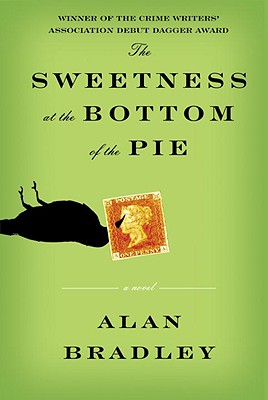
The Sweetness at the Bottom of the Pie


Sorry for the silence this past week-- I've been absurdly preoccupied. This is a novel I checked out of the public library a few days ago.

In his debut novel, Alan Bradley offers his readers the eleven year old Flavia de Luce. A precocious young girl, she is the youngest of three daughters, heavily occupied with chemistry. Her father, a widower and stamp enthusiast is alarmed when on a summer afternoon, their cook finds a dead Jack Snipe with a postage stamp skewered on its beak. That night Flavia overhears an argument in her father's study. The following morning she is fascinated to find a man in their garden's cucumber patch. With his dying breath he mutters a mysterious word and Flavia is off on the adventure of her life.
Though young and occasionally unkind, Flavia is irresistible. The reader follows her around town on her trusty bicycle, Gladys, while she conduct interviews and searches for clues in her private investigation. Bradley's mystery has plenty of layers of intrigue to keep the reader engaged while Flavia untangles the web.
Though the occasional plot thread proves to be dropped without much ceremony, it is an excellent mystery novel. Truly character driven, you read not just to find a killer, but to discover more about the cast of three dimensional figures Bradley creates. Energetically written, the 370 pages went quickly. There is a sequel out now, hopefully Bradley will be able to recapture what made this novel special again.

Sunday, May 29, 2011

Writing like it's my job... because it sort of is

Hooray! One of the pieces I submitted to a periodical this month has been officially accepted for publication. I've been trying to send at least one inquiry and one story per week. Some editors have been very slow at getting back to me.
This particular editor rejected the first story I sent (see below), but has accepted a review I wrote. The best part is, I'll be getting paid ten cents per word-- not a bad rate. The worst part is, I won't be getting paid until November when the issue is published.
Oh the life of a writer: work your tail off now, starve, get paid later. I sent off a story last week that I'm really proud of, to another magazine. I hope that I hear about it soon.

I've also decided to start more seriously seeking an agent now that the second round of edits on my murder mystery are nearing completion. I've also been feverishly working on the sequel. There's some really exciting mysteries for my main team, Victoria and Jacquelyn, to solve, not just one single case as in the first novel. There also may be a new romantic interest for one of them. I wasn't planning it, but the characters just seemed to have chemistry when I was writing a scene the other night. It will lead so well into the third story where I have major things planned.
The best part about this project is that I just enjoy spending time with my characters. Hopefully other people will too. If other people ever get the chance to read them.

Monday, April 4, 2011

A Crack in the Lens by Darlene Cypser


“Grit in a sensitive instrument, or a crack in one of his high powered lenses, would not be more disturbing than a strong emotion in a nature such as his.” -A Scandal in Bohemia
A young Sherlock Holmes returns to his home in the English countryside after living abroad for his health’s sake. He has a history of poor health, but now at age seventeen he’s gained strength in his time on the continent and through his study of fencing. He soon gets wrapped up in his home estate. His eldest brother, Sherrinford marries and the daughter of a tenant named Violet Rushdale catches young Sherlock’s eye. However, he is plagued by a tenuous relationship with his father, the squire. His father doesn’t think he’ll amount to much and intends to send Sherlock to study as an engineer.
His father engages a tutor to come prepare Sherlock for university. A mathematical genius, young Professor Moriarty arrives and soon he and Sherlock are engaged in a battle of wits that will endanger Sherlock and people he cares for.

Darlene Cypser paints a rich landscape for her Holmesian prequel. Well researched and thought out, it gives a possible beginning to Sherlock Holmes’ story. It gives a look at the young man before he became the calculating machine described by Watson and how his interest in solving the unsolvable originated. It’s a quick read with plenty of suspense.
Unlike prequels such as The Young Sherlock Holmes that had to rewrite history to make the story work, Cypser sticks with the story. Though initially, I was skeptical about her inserting of Moriarty into the story, Cypser fills out the image of Moriarty. She also develops a back story between Holmes and Moriarty that emphasizes why Holmes is so bent on Moriarty’s removal from society in “The Final Problem.”

Saturday, March 19, 2011

Only Two Performances Left...

So I'm taking a brief breather.
It's been going well-- not too disasterous (yet). It's been a busy week of trying to keep up with school work, my Etsy, and this show. Still, I'm feeling good about what I've put into it.
Before tech started I finished The Crack in the Lens by Darlene Cypser, I haven't had time to write a review yet, but that will be forthcoming. I'm also reading Sister Carrie (mostly while I'm doing laundry or eating lunch) and slowly working my way through The Dubliners.
I also finally bought Mumford and Sons' album, Sigh No More. It's lovely.
I miss being involved in the theatre, I've realized. I haven't been keeping up with it on a local or national level like I used to-- I've been so focused on my English studies. I even let my subscription to American Theatre Magazine run out.
As I turn my thoughts back to playwriting, I'd like to become more theatre-literate again.